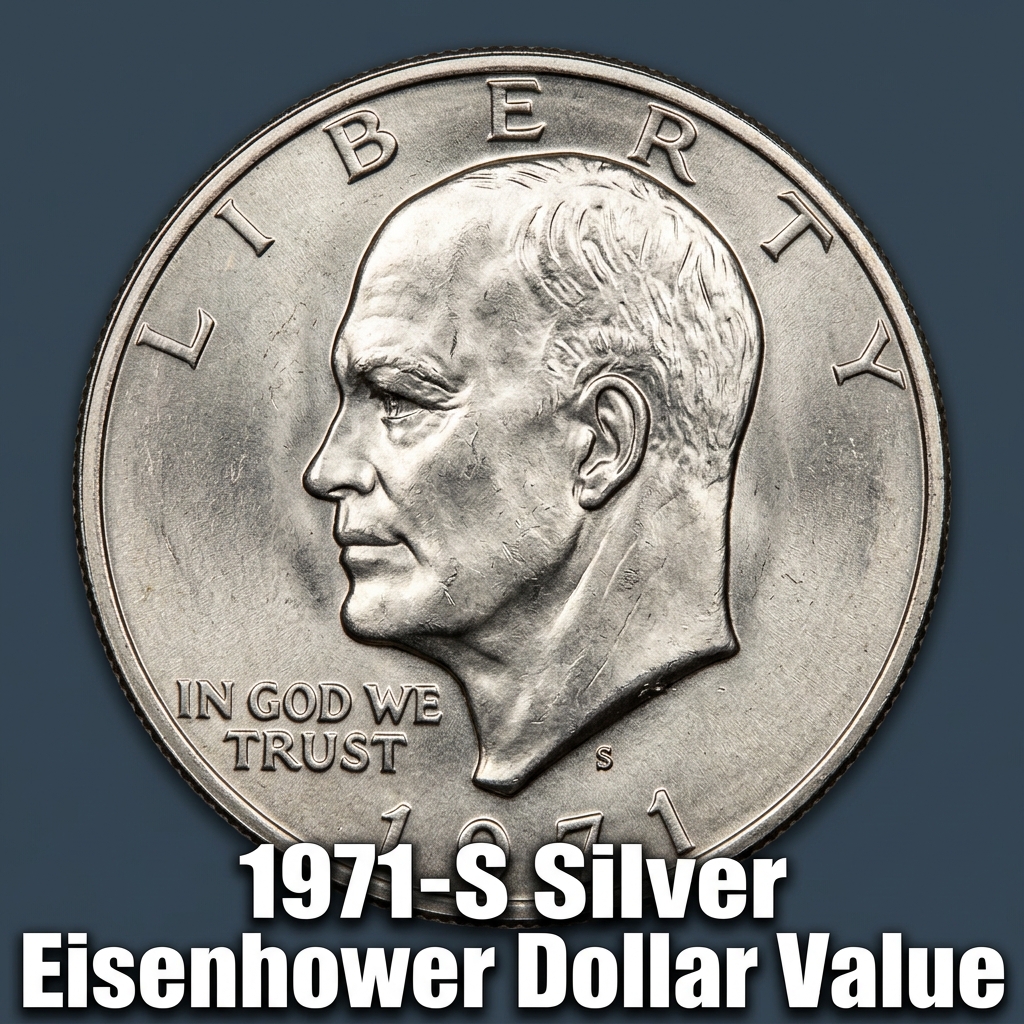

The 1971-S Silver Eisenhower Dollar is worth anywhere from $12 in circulated condition to over $100 or more in top mint state grades — and some proof versions can fetch even higher prices depending on their quality and eye appeal. If you’ve come across one of these big, impressive coins, you may be sitting on more than pocket change.
The 1971-S Silver Ike Dollar is a fascinating piece of American coinage history, and it’s one that many everyday collectors are surprised to find hiding in old coin collections or estate boxes. Whether you’re brand new to coins or just trying to figure out what grandma’s old silver dollar is worth, this guide will walk you through everything you need to know.
If you want a fast answer, you can use a free coin identifier app to scan your coin and get an instant estimate right from your phone — no experience needed.
—
What Makes the 1971-S Silver Eisenhower Dollar Special
Most Eisenhower dollars made in 1971 were struck in copper-nickel clad at the Philadelphia and Denver mints. But the San Francisco Mint — that’s what the “S” mintmark stands for — produced two special versions: a 40% silver uncirculated coin and a 40% silver proof coin.
These silver versions were sold directly to collectors through the U.S. Mint in special packaging, which means they were never meant for everyday circulation. That alone sets them apart from the common clad versions.
Because they contain real silver, the 1971-S Ike dollar has both numismatic (collector) value and intrinsic metal value. Even a worn or average example is worth more than face value, simply because of its silver content.
—
1971-S Silver Eisenhower Dollar Value by Grade and Type
The value of a 1971-S Silver Eisenhower Dollar depends heavily on its condition and whether it’s a business strike (uncirculated) or a proof. Proof coins have mirror-like fields and frosted design elements, and they tend to appeal strongly to collectors.
Here’s a general value breakdown:
| Type | Condition | Estimated Value |
|---|---|---|
| Silver Uncirculated (Blue Ike) | MS-60 to MS-63 | $12 – $20 |
| Silver Uncirculated (Blue Ike) | MS-65 and above | $30 – $100+ |
| Silver Proof (Brown Box) | PR-65 | $15 – $25 |
| Silver Proof (Brown Box) | PR-69 DCAM | $50 – $200+ |
For a more detailed look at certified sale prices and recent auction data, check out this 1971-S Silver Eisenhower Dollar price guide across mint state grades — it’s a great resource for understanding what buyers are actually paying right now.
—
How to Tell If Your 1971 Dollar Is Silver
This is probably the most common question people have: “Is my 1971 Eisenhower dollar actually silver?”
The first thing to check is the mintmark. Flip the coin over and look just above the eagle’s head on the reverse side. If you see a small “S,” that’s a good sign. However, not all 1971-S coins are silver — some were proof coins in clad as well, so you’ll want to look more carefully.
The easiest way to confirm silver content is to look at the edge of the coin. A silver 1971-S Ike dollar will have a solid silver edge with no copper stripe visible. If you see a reddish-orange layer sandwiched between silver layers, it’s clad — not silver.
You can also weigh the coin. A 40% silver Ike dollar weighs approximately 24.59 grams, compared to 22.68 grams for the clad version. A simple digital kitchen scale can help you tell the difference in seconds.
If you’re still not sure, CoinKnow can help you identify your coin quickly and give you a real-time value estimate based on current market data.
—
What Affects the 1971-S Silver Eisenhower Dollar’s Value Most
Condition is king in the coin world, and that’s especially true for the 1971-S Silver Ike. Since these coins were sold as collectibles and never circulated, most of them stayed in reasonably good shape. But that also means collectors have high standards — any bag marks, hairlines from cleaning, or dull luster can significantly knock the value down.
Original packaging matters too. If you have the blue envelope (for uncirculated) or the brown box (for proof) that the coin originally came in, that can help preserve the coin’s grade appeal and add a small premium for certain buyers.
Professional grading from services like PCGS or NGC can dramatically increase a coin’s marketability and confirmed value, especially for high-grade examples. A PR-69 Deep Cameo proof graded by a major service can sell for several times more than an ungraded coin of similar appearance.
For a full breakdown of what a 1971 silver dollar is worth based on grade and type, this resource covers the key value factors in plain language.
—
Should You Sell, Hold, or Grade Your 1971-S Silver Ike?
If your coin is in average condition — no cleaning, no damage, but no spectacular eye appeal either — it’s likely worth $12 to $25 based on silver content alone. That’s still a nice return on what was originally a $3 purchase price from the U.S. Mint.
If your coin looks gem-quality, with brilliant luster and sharp detail, it could be worth having it professionally graded. Coins grading MS-67 or PR-69 DC can fetch $100 to $200 or more at auction.
Not sure where to start? Download CoinKnow, snap a photo of your coin, and let the app do the heavy lifting. It’s one of the easiest ways to get a reliable value estimate without needing to be an expert yourself.
—
FAQ
Q: How much silver is in a 1971-S Eisenhower dollar?
A: The 1971-S Silver Eisenhower dollar contains 40% silver and 60% copper. It weighs 24.59 grams, which means it has roughly 0.3161 troy ounces of silver. At current silver prices, the melt value alone is typically around $8 to $10, though the collector value is often higher.
Q: How do I know if my 1971-S Eisenhower dollar is real silver or clad?
A: Check the edge of the coin. A genuine 40% silver 1971-S Ike dollar will show a pure silver-colored edge with no visible copper layer. You can also weigh it — the silver version weighs about 24.59 grams versus 22.68 grams for the clad version. A CoinKnow scan can also help you identify it instantly.
Q: Is the 1971-S Silver Eisenhower Dollar rare?
A: It’s not extremely rare — the U.S. Mint produced about 6.8 million uncirculated silver versions and 4 million proof versions in 1971. However, high-grade examples (MS-67 or PR-69 DCAM) are genuinely scarce and command strong premiums among serious collectors.