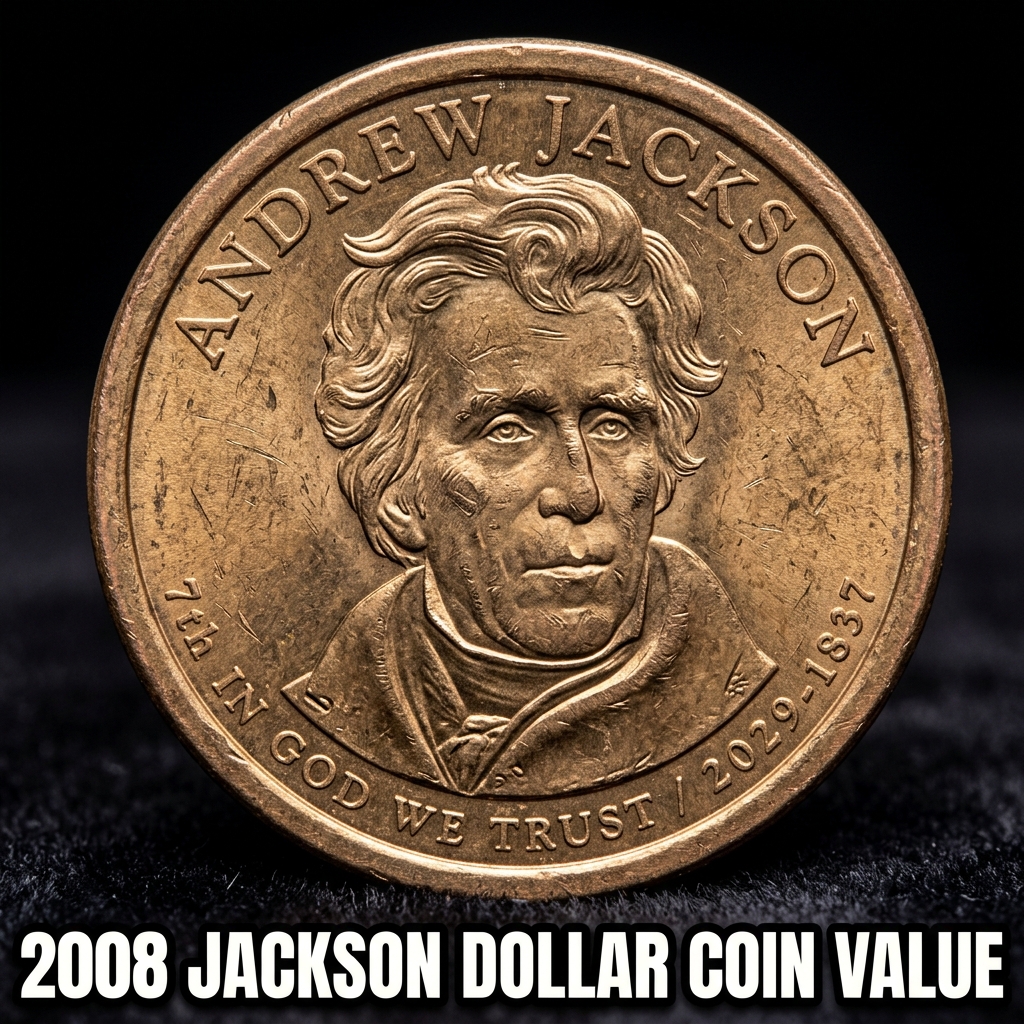

The 2008 Andrew Jackson Presidential Dollar is worth face value — just $1 — in circulated condition, but uncirculated examples and error coins can fetch anywhere from $5 to over $100 depending on the variety and grade. If you’ve got one sitting in a drawer or found it in change, here’s exactly what you need to know.
What Is the 2008 Jackson Dollar?
The 2008 Andrew Jackson Presidential Dollar was released as part of the U.S. Mint’s Presidential Dollar Program, which ran from 2004 to 2016. Each year featured four U.S. presidents in the order they served, and Andrew Jackson — the 7th President — was one of the four coins issued in 2008.
These golden-colored coins are made of a manganese-brass clad composition, not actual gold. They measure 26.5mm in diameter and weigh 8.1 grams. The obverse features a portrait of Jackson with his name, the years he served (1829–1837), and the inscription “IN GOD WE TRUST.” The reverse shows the Statue of Liberty, a design shared across all Presidential Dollars.
If you want to quickly identify your coin and confirm what you have, using a free coin identifier app is a great starting point — especially if you’re not sure which president or mint mark you’re looking at.
How Much Is the 2008 Jackson Dollar Worth?
For most people, the honest answer is that a circulated 2008 Jackson Dollar from pocket change is worth $1. These coins were produced in massive numbers for general circulation and don’t carry a premium in worn grades.
That said, uncirculated coins — meaning coins that were never used in everyday transactions — do carry some value above face. Mint State examples graded MS65 or higher can sell for $5 to $15 in some cases. Proof versions, which were struck specifically for collectors using polished dies, can be worth $10 to $25 or more in top grades.
The real excitement, however, comes from error coins. Missing edge lettering errors (where the “E PLURIBUS UNUM,” date, and mint mark are absent from the coin’s edge) can push values significantly higher — sometimes $50 to $100 or more for a clean example.
| Coin Type | Condition | Estimated Value |
|---|---|---|
| 2008-P Jackson Dollar | Circulated | $1 (face value) |
| 2008-D Jackson Dollar | Circulated | $1 (face value) |
| 2008-P Jackson Dollar | MS65 Uncirculated | $5 – $10 |
| 2008-D Jackson Dollar | MS65 Uncirculated | $5 – $10 |
| 2008-S Jackson Dollar (Proof) | PR69 Deep Cameo | $12 – $25 |
| 2008-P/D Missing Edge Lettering Error | Various | $50 – $100+ |
Mint Marks and Mintage Numbers
The 2008 Jackson Dollar was produced at two mints for circulation — Philadelphia (P) and Denver (D) — plus San Francisco (S) for collector proof sets.
The Philadelphia Mint struck approximately 61,180,000 Jackson Dollars, while the Denver Mint produced around 61,070,000. These are substantial mintages, which is one reason why the circulated versions don’t carry much of a premium. By contrast, the San Francisco Proof version had a much lower mintage of roughly 3,000,000, making those examples slightly more collectible.
If you’re curious how Presidential Dollar mintages compare to other collectible dollar coins, it’s worth exploring rare Eisenhower dollar values and mintage data — Ike Dollars from the 1970s often show how mintage directly affects collectibility and price over time.
What Makes a 2008 Jackson Dollar Valuable?
Beyond the standard issues, a few specific factors can push the 2008 Jackson Dollar coin value above the norm.
Edge lettering errors are the most commonly discussed. Presidential Dollars had the date, mint mark, and mottoes inscribed on the edge of the coin — a unique feature of the series. When the edge lettering step was accidentally skipped, these became known as “plain edge” or “godless dollars” (since “IN GOD WE TRUST” appears on the edge in some years). Error coins like these are genuinely sought after by collectors.
High-grade examples certified by PCGS or NGC in MS67 or higher can also attract premium prices at auction. CoinKnow can help you quickly assess where your coin might fall in terms of grade before you invest in professional grading.
Additionally, coins with strong strikes, original luster, and no post-mint damage are always worth more than average examples, even without a formal certification. For reference, you can compare modern dollar coin pricing trends by looking at current MS-grade Peace Dollar price data to understand how grade impacts value across the dollar coin market.
Should You Hold Onto It or Sell?
For most people with a circulated 2008 Jackson Dollar, the coin is worth keeping as a fun piece of American history but probably won’t make you rich. However, if you suspect you have an error coin — especially a missing edge lettering variety — it’s absolutely worth getting it authenticated.
Use CoinKnow to scan and identify your coin before making any decisions. The app gives you instant information on mint marks, known varieties, and estimated values, making it easy even if you’re brand new to coin collecting.
If you do decide to sell, platforms like eBay, coin shows, and local dealers are all reasonable options. Error coins and high-grade certified examples will always fetch better prices than raw, uncertified coins, so professional grading is worth considering if you think you have something special. And remember — even a $1 face value coin has a story worth knowing.
—
FAQ
Q: Is the 2008 Jackson Dollar made of real gold?
A: No. The coin has a golden color due to its manganese-brass clad composition, but it contains no actual gold. It’s made of a copper core with an outer layer of manganese-brass alloy.
Q: How do I know if my 2008 Jackson Dollar has a missing edge lettering error?
A: Look at the edge of the coin carefully. A normal 2008 Jackson Dollar will have inscriptions including “E PLURIBUS UNUM,” the date, mint mark, and “IN GOD WE TRUST” running along the edge. If the edge is completely blank and smooth, you likely have an error coin worth significantly more than face value.
Q: Where is the best place to sell a valuable 2008 Jackson Dollar?
A: For high-grade or error coins, certified auction houses and online platforms like eBay tend to bring the best prices. For common circulated examples, a local coin dealer or coin show is a quick and easy option. Using CoinKnow beforehand helps you understand your coin’s value so you don’t undersell it.