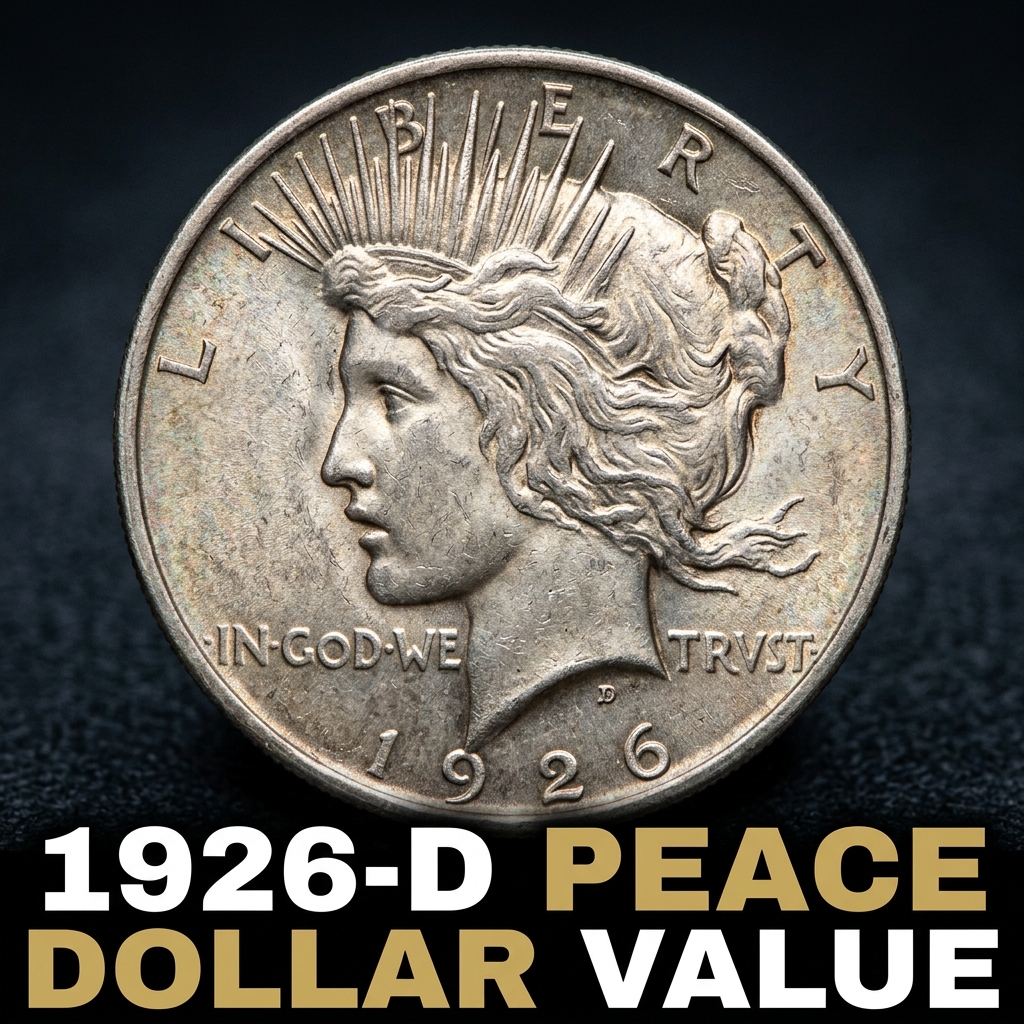

The 1926-D Peace Dollar is worth anywhere from $30 in heavily worn condition to well over $500 or more in high mint state grades — and some certified examples have sold for thousands. If you found one of these silver beauties tucked away in a drawer or coin collection, you’re in the right place to find out exactly what it’s worth.
What Makes the 1926-D Peace Dollar Special
The 1926-D Peace Dollar was struck at the Denver Mint in 1926, carrying the small “D” mintmark on the reverse side, just above the “ONE” in “ONE DOLLAR.” This was part of the iconic Peace Dollar series, which ran from 1921 to 1935, designed by sculptor Anthony de Francisci as a symbol of peace following World War I.
With a mintage of around 2,348,700 coins, the 1926-D isn’t the rarest Peace Dollar, but it’s far from common in high grades. Most surviving examples have seen heavy circulation, which means finding one in great shape can make a significant difference in its value.
If you want to quickly check whether your coin is the real deal, a free coin identifier app can help you scan and identify it right from your phone — no coin dealer visit needed.
1926-D Peace Dollar Value by Grade
The condition of your coin — what coin collectors call its “grade” — is the single biggest factor in determining how much it’s worth. A coin in poor, scratched condition and one in brilliant uncirculated condition can differ in value by hundreds of dollars.
Here’s a general value breakdown for the 1926-D Peace Dollar:
| Grade | Description | Estimated Value |
|---|---|---|
| G-4 (Good) | Heavy wear, design visible | $28 – $35 |
| VG-8 (Very Good) | Moderate wear, clear details | $35 – $45 |
| F-12 (Fine) | Moderate to light wear | $45 – $60 |
| EF-40 (Extremely Fine) | Light wear on high points | $70 – $100 |
| MS-63 (Uncirculated) | No wear, some marks | $300 – $500 |
| MS-65 (Gem Uncirculated) | Sharp, lustrous, minimal marks | $1,500+ |
For the most up-to-date 1926-D Peace Dollar price data across mint state grades, it’s worth bookmarking a reliable price tracker so you’re always working with current market numbers.
How to Tell If Your 1926-D Is in Good Shape
Start by looking at Liberty’s hair above her ear and the feathers on the eagle’s breast on the reverse — these are the first areas to show wear. If those details are sharp and well-defined, your coin is likely in a higher grade.
Avoid cleaning your coin. A cleaned 1926-D Peace Dollar is worth significantly less than a naturally toned one of the same grade. Coin collectors refer to cleaned coins as “details coins,” and they often sell for 30–50% less than problem-free examples.
CoinKnow is a great tool for getting a quick visual assessment of your coin’s condition. Just snap a photo and let the app analyze it — it’s especially useful when you’re not sure whether a coin is worth getting professionally graded.
Is the 1926-D Peace Dollar Worth Getting Graded?
Professional grading from services like PCGS or NGC can be worth every penny if your coin appears to be in uncirculated condition. In a plastic slab with a certified grade, a 1926-D Peace Dollar MS-63 or higher can sell for multiples of what a raw, ungraded coin fetches.
That said, if your coin looks worn and circulated, the cost of grading (typically $30–$50 per coin) may not make financial sense. For a quick gut check before spending money on grading, use CoinKnow to get an estimated grade and value range instantly.
You can also check out this detailed 1926 silver dollar value breakdown to compare the Philadelphia, Denver, and San Francisco mint versions side by side.
The Silver Melt Value Factor
Even in the most worn condition, your 1926-D Peace Dollar has real intrinsic value because it contains 90% silver. Each coin has approximately 0.7734 troy ounces of pure silver. With silver prices fluctuating around $28–$30 per ounce (as of recent market data), the base melt value alone sits around $22–$23.
This means a 1926-D Peace Dollar in any condition is worth more than pocket change. Even the most beat-up example is worth picking up, saving, or selling to a coin dealer. CoinKnow can pull live silver spot prices to calculate your coin’s melt value in real time — a handy feature for silver stacks and casual collectors alike.
FAQ
Q: How do I find the mintmark on my 1926 Peace Dollar?
A: Flip the coin over to the reverse side (the eagle side). Look just above the word “ONE” at the bottom — you’ll see a small letter. A “D” means it was made in Denver, an “S” means San Francisco, and no mintmark means it came from Philadelphia.
Q: Is the 1926-D Peace Dollar rare?
A: It’s not considered rare in circulated grades, but it becomes scarce in high mint state grades like MS-64 and above. Finding a problem-free, uncirculated 1926-D is a genuine challenge, which is why those examples command strong premiums at auction.
Q: Should I clean my 1926-D Peace Dollar before selling it?
A: Absolutely not. Cleaning a coin — even gently — damages the surface and removes the original luster that collectors pay for. A naturally toned, uncleaned coin will always be worth more than a polished one. If dirt bothers you, simply store it safely and leave the cleaning to a professional conservator if ever needed.