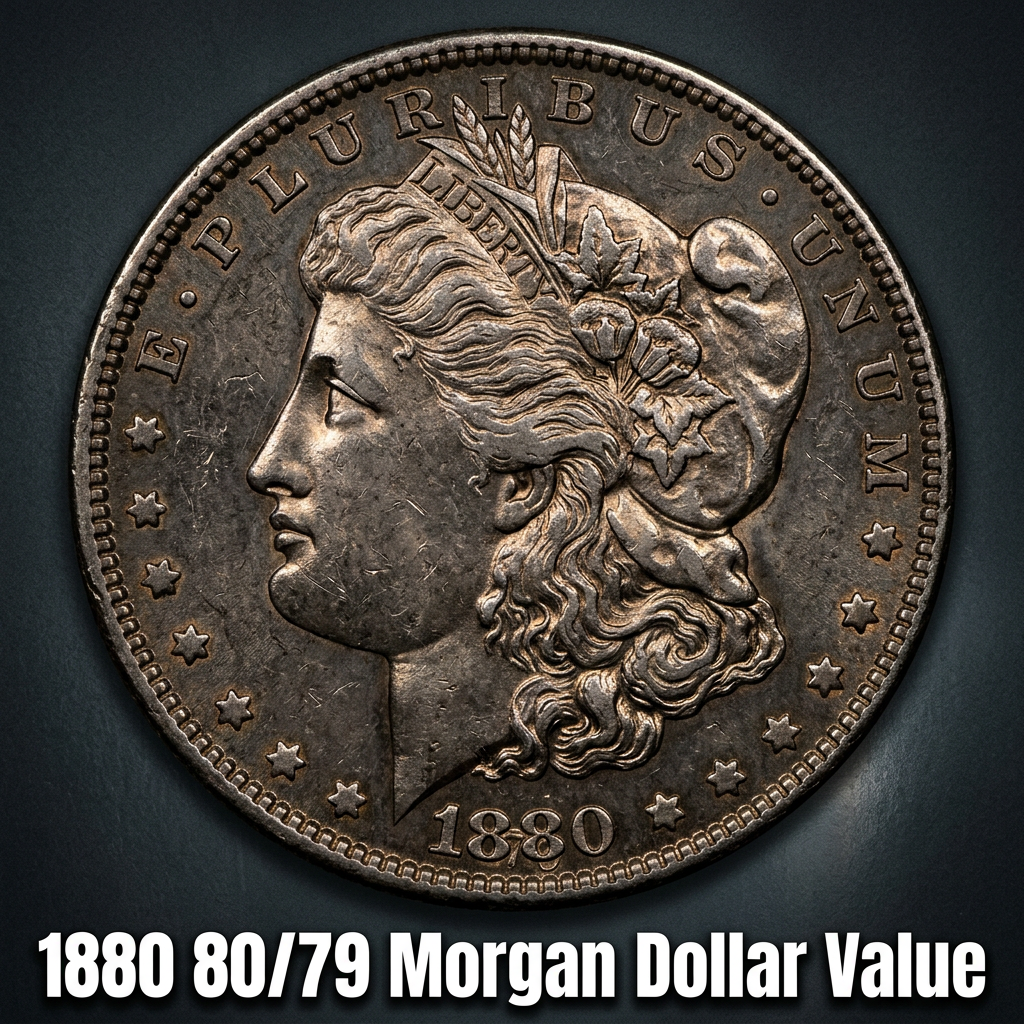

The 1880 80/79 Morgan Dollar is worth anywhere from $30 in heavily worn condition to well over $500 in uncirculated grades — and certain high-grade examples have sold for thousands at auction. If you’ve got one of these coins sitting in a drawer or inherited it from a relative, you’re holding something genuinely interesting. This guide breaks down exactly what it’s worth and why.
What Makes the 1880 80/79 Morgan Dollar Special
The 1880 Morgan Dollar is already a popular coin among collectors, but the 80/79 variety takes things up a notch. This is what’s known as an overdate — a coin where the die was re-engraved, and you can actually see the remnants of the “79” underneath the “80” in the date. That kind of minting curiosity is exactly what drives collectors wild.
The Philadelphia Mint produced this variety, and it’s considered a recognized VAM (Van Allen-Mallis) variety. VAM collecting has a devoted following, and the 1880 80/79 is one of the more accessible overdates for everyday collectors.
If you’re not sure whether your coin has this feature, try using a free coin identifier app to get a quick read on what you’re holding. It won’t replace a professional opinion, but it’s a great starting point before you invest time or money into getting it appraised.
How Much Is the 1880 80/79 Morgan Dollar Worth by Grade
The value of this coin depends heavily on its condition. Coin collectors use a 70-point scale called the Sheldon scale to grade coins — from Poor (P-1) at the bottom all the way to Perfect Mint State (MS-70) at the top. For most Morgan Dollars, the real jump in value happens once you get into uncirculated territory.
Here’s a general look at 1880 Morgan Dollar price data across different grades to help you understand where the 80/79 variety fits in:
| Grade | Description | Estimated Value |
|---|---|---|
| G-4 (Good) | Heavy wear, date and design visible | $30 – $40 |
| VF-20 (Very Fine) | Moderate wear, details clear | $45 – $65 |
| EF-40 (Extremely Fine) | Light wear on high points | $70 – $100 |
| AU-55 (About Uncirculated) | Slight wear, most luster remains | $110 – $180 |
| MS-63 (Choice Uncirculated) | No wear, some minor marks | $250 – $400 |
| MS-65 (Gem Uncirculated) | Strong luster, minimal contact marks | $500 – $1,000+ |
Keep in mind that as a recognized VAM variety, the 80/79 overdate often commands a small premium above standard 1880-P Morgan Dollar prices, especially among specialty collectors.
How to Tell If Your Coin Has the 80/79 Overdate
Finding the overdate on your coin requires magnification — at least 5x to 10x. Look closely at the “8” and “0” in the date. On a genuine 80/79 overdate, you should see traces of the “7” and “9” tucked underneath. The remnants of the old digits are subtle but visible once you know what to look for.
If you’re squinting at your coin and still not sure, that’s completely normal. Many everyday collectors use the CoinKnow app to get an initial identification before taking a coin to a dealer. It’s a handy tool that can help you figure out whether your coin is worth pursuing further.
You can also cross-reference with detailed 1880 silver dollar value information to compare your coin against known examples and pricing benchmarks.
What Affects the Value Beyond Grade
Grade isn’t the only factor. A few other things can push the value of your 1880 80/79 Morgan Dollar up or down:
Luster and eye appeal — A coin that technically grades MS-63 but has brilliant, flashy luster will always sell better than a dull one at the same grade. Eye appeal matters enormously in the collector market.
Certification — Coins graded and certified by PCGS or NGC typically sell for more than raw (ungraded) coins of the same quality. If you think your coin is in uncirculated condition, getting it certified could be well worth the cost.
VAM attribution — If your coin is properly attributed as the 80/79 VAM variety by a recognized grading service, that label adds value and makes the coin far easier to sell to the right buyer.
Silver melt value — At its base level, your Morgan Dollar contains 0.7734 troy ounces of silver. With silver prices hovering around $28–$32 per ounce, even a worn example is worth at least $20–$25 just for its metal content. So the floor on any Morgan Dollar is never zero.
The CoinKnow app is a great resource for tracking silver melt values in real time alongside collector premiums, so you always know where you stand.
Should You Sell, Hold, or Get It Graded
If your coin is in good or very fine condition, you could sell it fairly easily at a coin show or through an online marketplace like eBay for $30–$70. That’s a nice return on a coin you might have found in grandma’s jewelry box.
If it looks uncirculated — meaning no obvious wear on the high points of the design — definitely consider getting it professionally graded before selling. The difference between selling a raw MS-63 Morgan Dollar and a PCGS-certified MS-63 can sometimes be $100 or more. Certification also gives buyers confidence, which means faster sales and better prices.
And if you’re not in a rush, Morgan Dollars have shown strong, steady collector demand for decades. Holding onto it isn’t a bad play either.
FAQ
Q: How do I know if my 1880 Morgan Dollar is the 80/79 overdate variety?
A: You’ll need a magnifying glass or loupe with at least 5x–10x magnification. Look at the last two digits of the date — if you can see faint traces of a “7” and “9” beneath the “8” and “0,” you likely have the overdate. A coin dealer or grading service can confirm it officially.
Q: Is the 1880 80/79 Morgan Dollar rare?
A: It’s not an extremely rare coin, but it is a recognized and sought-after VAM variety. Its rarity is moderate — common enough that collectors can find examples, but scarce enough that high-grade specimens attract real competition at auction.
Q: Where is the best place to sell an 1880 80/79 Morgan Dollar?
A: For worn examples, eBay or a local coin show works fine. For higher-grade or certified coins, consider major auction houses like Heritage Auctions or Stack’s Bowers, where serious VAM collectors are actively bidding. You can also use CoinKnow to research recent sale prices before you list your coin anywhere.