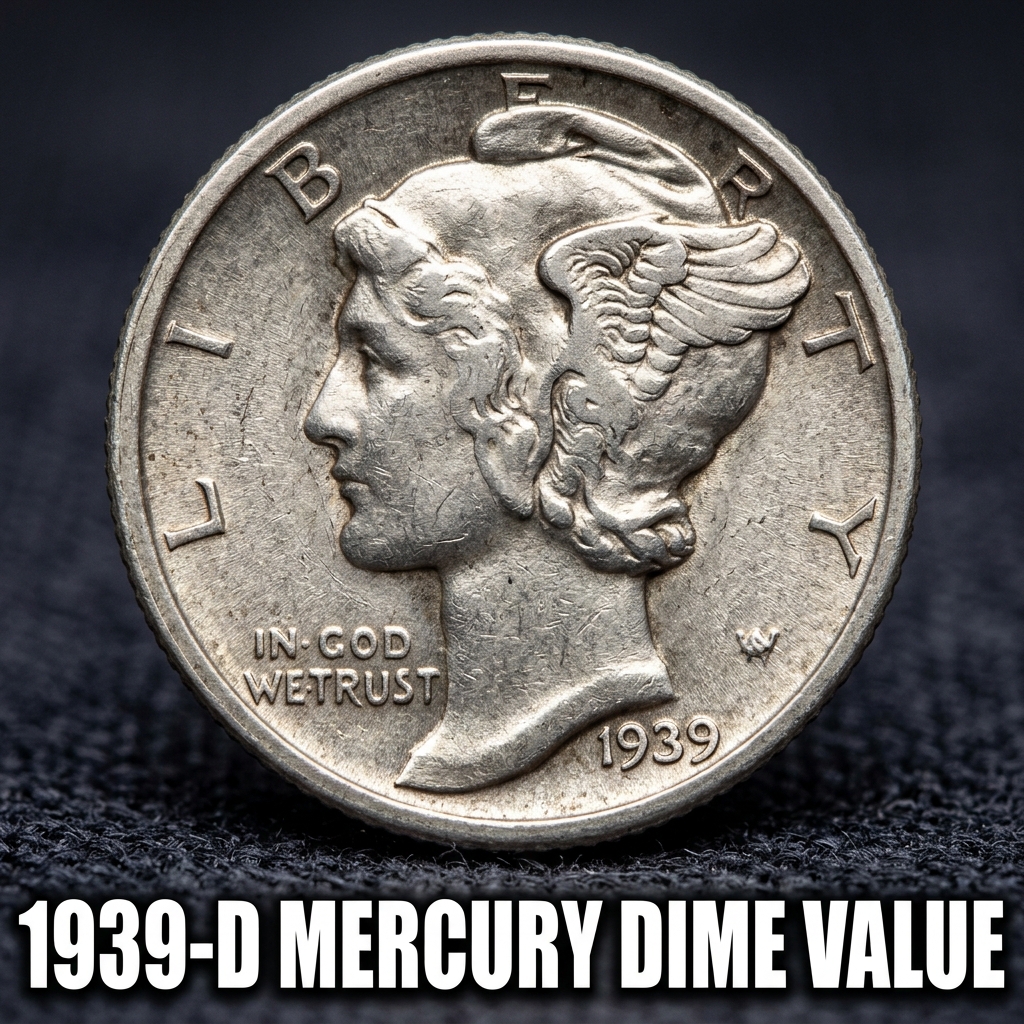

The 1939-D Mercury Dime is worth anywhere from $3 to $5 in heavily worn condition, but can fetch $20 to $100 or more in better grades — and in pristine mint state, top examples have sold for several hundred dollars. If you’ve got one of these sitting in an old coin jar or inherited collection, you’re in the right place to find out exactly what it’s worth.
What Makes the 1939-D Mercury Dime Special
The 1939-D Mercury Dime was struck at the Denver Mint, one of three facilities producing Mercury Dimes that year (the others being Philadelphia and San Francisco). The “D” mintmark appears on the reverse side of the coin, just above the “E” in “ONE.”
Mercury Dimes, officially called Winged Liberty Head Dimes, were designed by Adolph A. Weinman and minted from 1916 to 1945. They’re widely considered one of the most beautiful American coins ever made. The obverse features Lady Liberty wearing a winged cap — often mistaken for the Roman god Mercury, which is how the nickname stuck.
The 1939-D had a mintage of 24,394,000 coins. That’s not a tiny number, but it’s not astronomically large either. Enough survive today that you won’t be hunting forever to find one, but enough circulated heavily that nice examples are harder to come by. If yours still has sharp details and good luster, it could be worth significantly more than a worn example.
If you’re not sure what you’ve got, using a free coin identifier app can help you quickly confirm the date, mintmark, and condition of your coin before you try to sell or grade it.
1939-D Mercury Dime Value by Grade
Coin value is almost entirely tied to condition — what collectors call “grade.” A coin that’s been in someone’s pocket for decades looks very different from one that was carefully stored since the day it was made. Here’s a general breakdown of what the 1939-D Mercury Dime is worth at various grades:
| Grade | Description | Estimated Value |
|---|---|---|
| Good (G-4) | Heavy wear, design visible | $3 – $4 |
| Fine (F-12) | Moderate wear, details present | $4 – $6 |
| Extremely Fine (EF-40) | Light wear on high points | $10 – $18 |
| About Uncirculated (AU-55) | Slight wear, most luster intact | $20 – $35 |
| MS-63 (Mint State) | No wear, minor contact marks | $45 – $80 |
| MS-65+ (Gem) | Near-perfect, full luster | $100 – $300+ |
You can check detailed 1939-D Mercury Dime price data across mint state grades to see how certified coins have actually sold at auction — it’s a great way to see real-world numbers beyond general estimates.
The Full Split Bands Detail That Collectors Love
Here’s something many casual coin finders don’t know: Mercury Dimes have a special feature on the reverse called the “bands” on the fasces (that’s the bundle of sticks and axe shown on the back). When those horizontal bands show complete, separate lines with no merging — called “Full Split Bands” or FSB — the coin becomes dramatically more valuable.
A 1939-D Mercury Dime graded MS-65 might sell for around $80 to $100. But the same coin graded MS-65 FSB (Full Split Bands) can jump to $200 or even more. It’s a small detail that makes a huge difference in the collector market.
Not every coin has this feature because the bands were often the first area to show weak strikes or wear. If you hold your coin under good light and see crisp, distinct lines in the bands on the reverse, it’s worth getting a professional opinion.
CoinKnow is a handy app that helps everyday people like you understand grading details like Full Split Bands, even if you’ve never collected coins before. It breaks down what to look for in plain language and helps you figure out if your coin deserves a closer look.
Silver Content and Melt Value
One thing that always gives Mercury Dimes a floor value is their silver content. Every Mercury Dime — including the 1939-D — is made of 90% silver. Each coin contains 0.07234 troy ounces of pure silver.
With silver prices typically hovering in the $25 to $30 per troy ounce range, the melt value of a 1939-D Mercury Dime sits around $1.80 to $2.20. That means even a heavily worn, nearly unreadable example is worth more than face value — it’s worth holding onto.
For well-preserved examples, collector value always exceeds melt value by a wide margin. But it’s good to know that silver gives these coins a built-in baseline that will only rise if silver prices climb.
How to Find Out What Your 1939-D Mercury Dime Is Really Worth
If you’re trying to get a real number for your specific coin, the best approach is to assess condition honestly, check recent sales, and consider professional grading if it looks like it’s in great shape.
For a quick start, this resource covering 1939 Mercury Dime values across all grades and mintmarks gives you a solid breakdown to compare against what you’ve got in hand.
You can also use CoinKnow to photograph your coin and get an instant condition estimate. It’s designed for people who aren’t professional coin dealers — just regular folks who want straight answers without learning the whole hobby from scratch.
For coins that look like they might be in mint state or have Full Split Bands, submitting to a third-party grading service like PCGS or NGC is worth considering. A graded and slabbed coin sells for significantly more than an ungraded one, because buyers trust the certification.
—
Frequently Asked Questions
Q: How do I know if my Mercury Dime is the 1939-D and not another year or mint?
A: Flip the coin over and check the date on the front — it should clearly read 1939. Then look at the reverse near the bottom of the coin, just above the “E” in “ONE.” A small “D” mintmark there confirms it was struck at the Denver Mint. No letter means Philadelphia; “S” means San Francisco.
Q: Is a 1939-D Mercury Dime worth getting professionally graded?
A: It depends on the condition. If your coin shows strong details, original luster, and possibly full split bands on the reverse, professional grading can significantly increase its resale value. For heavily worn examples worth only a few dollars, the grading fee likely isn’t worth it. Use CoinKnow or check recent auction sales first to gauge if grading makes financial sense.
Q: Where’s the best place to sell a 1939-D Mercury Dime?
A: For common worn examples, online platforms like eBay work well — there’s always a buyer for silver coins. For higher-grade pieces, consider coin shows, established dealers, or auction houses that specialize in numismatics. Always get a second opinion before selling if you think your coin might be in exceptional condition.