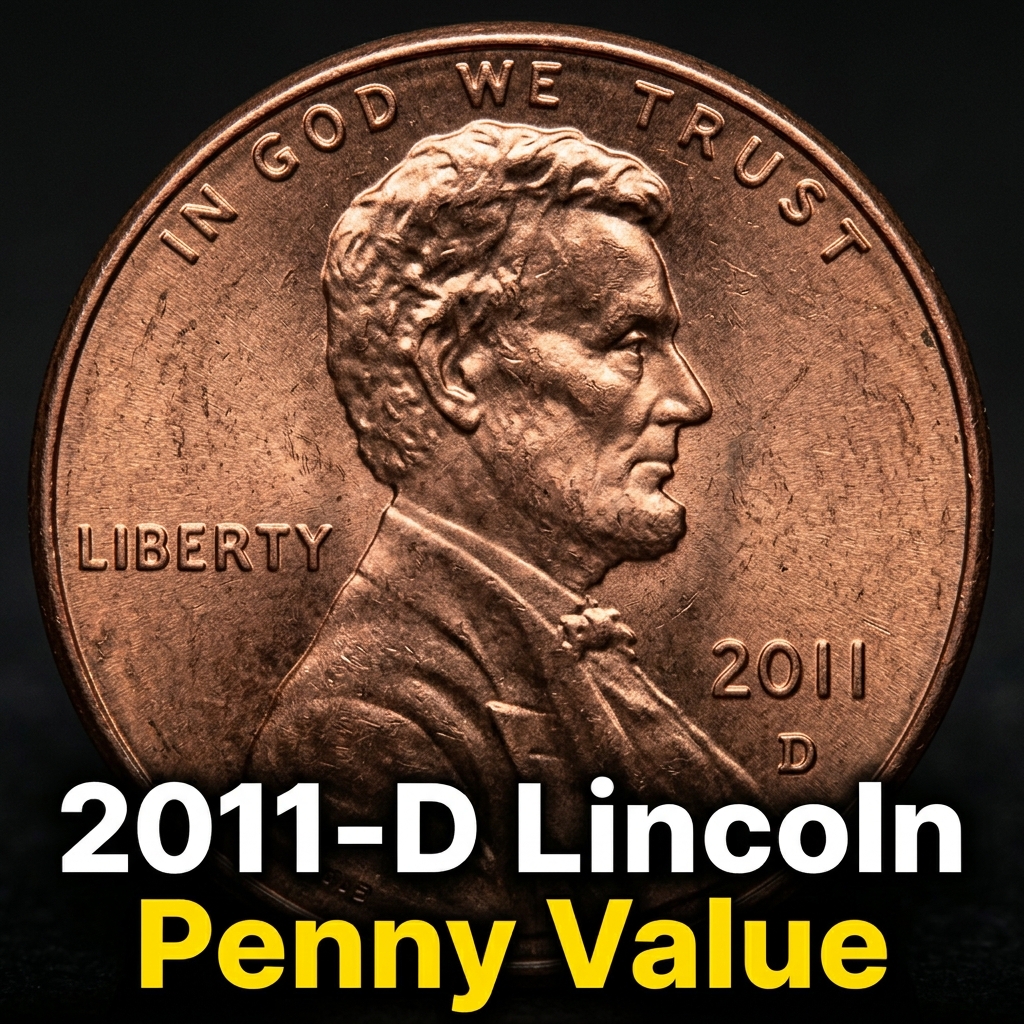

The 2011-D Lincoln Penny is worth anywhere from face value up to $10 or more in pristine, uncirculated condition. Most of these coins you’ll find in your pocket change are worth exactly one cent, but high-grade examples or error coins can be worth a surprising amount more. If you recently found one and are wondering whether it’s a keeper, you’ve come to the right place.
Before we dive in, if you want a quick and easy way to check your coins, try using a free coin identifier app to get an instant idea of what you’re holding. It can save you a lot of guesswork before you decide to sell or keep a coin.
What Is the 2011-D Lincoln Penny?
The 2011-D Lincoln Penny was struck at the Denver Mint, which is indicated by the small “D” mintmark you’ll find on the obverse (front) of the coin, just below the date. In 2011, the reverse of the Lincoln cent featured the Union Shield design, which replaced the earlier Lincoln Bicentennial designs and has been used ever since.
The Denver Mint produced over 2.1 billion of these coins in 2011, making it one of the most common modern cents in existence. Because of that high mintage, circulated examples are essentially worth face value. However, coins that were never used and have been carefully preserved can be worth more to collectors.
The coin is composed of 97.5% zinc and 2.5% copper, giving it that familiar copper-toned appearance. It weighs 2.5 grams and measures 19.05 mm in diameter — standard specs for the modern Lincoln cent.
2011-D Lincoln Penny Value by Grade
The value of your 2011-D penny depends almost entirely on its condition, or “grade.” Coin grading uses a scale from 1 to 70, with 70 being a perfect uncirculated coin. Here’s a general breakdown:
| Grade | Condition Description | Estimated Value |
|---|---|---|
| Good (G-4) | Heavy wear, design visible | Face value ($0.01) |
| Fine (F-12) | Moderate wear, details clear | Face value ($0.01) |
| Extremely Fine (EF-40) | Light wear on high points | $0.05 – $0.10 |
| Mint State 63 (MS-63) | Uncirculated, minor blemishes | $0.50 – $1.00 |
| Mint State 65 (MS-65) | Gem uncirculated, strong luster | $2.00 – $5.00 |
| Mint State 67 (MS-67) | Superb gem, nearly flawless | $8.00 – $15.00+ |
For a more detailed look at certified auction prices, you can browse graded 2011-D Lincoln penny prices across MS condition levels to see what professionally certified examples are actually selling for.
Are There Any Valuable 2011-D Penny Errors?
Error coins are where things get really interesting for collectors. Even a common coin like the 2011-D penny can be worth significantly more if it has a minting mistake. Some error types to look for include:
Doubled Die Errors — Look closely at the lettering or Lincoln’s portrait for doubling. A noticeable doubled die on a 2011-D penny can push its value into the $25–$100+ range depending on the severity.
Off-Center Strikes — If the design is noticeably off-center, you may have a coin worth $10 to $50 or more. The more dramatic the error, the higher the value.
Die Cap and Brockage Errors — These are rarer and can be worth hundreds of dollars if authenticated.
If you think you have an error coin, it’s worth having it examined professionally. CoinKnow is a great starting point for identifying whether your coin looks unusual — the app uses visual recognition to flag potential errors and anomalies quickly, without needing any coin expertise on your part.
How to Check If Your 2011-D Penny Is Worth More
So you’ve found a 2011-D penny — what should you do next? Start by looking at it under good lighting and a magnifying glass. Check for any doubling in the lettering, off-center printing, or unusual surface textures.
Next, assess the overall condition. Is it shiny and lustrous with no visible wear? That suggests it may be in mint state, which opens the door to collector value. If it’s dull and scratched from years of pocket change, it’s most likely worth face value.
You can also check current 2011 penny value estimates and variety information to compare your coin against known reference points and see where yours might fall on the spectrum.
For an even faster assessment, CoinKnow lets you scan the coin with your phone camera and get an instant identification with estimated value ranges — a handy tool for beginners and experienced collectors alike.
Should You Hold Onto Your 2011-D Penny?
For most people, the 2011-D Lincoln penny in average circulated condition is simply a one-cent coin. But if yours is in exceptional shape — no wear, bright red luster, sharp details — it could be worth holding onto or submitting to a grading service like PCGS or NGC.
Error coins should absolutely be preserved and researched further. Even a modest error can turn a one-cent coin into a $50 find. CoinKnow can help you quickly figure out whether what you’re seeing is a genuine mint error or just normal die wear.
The bottom line: most 2011-D pennies won’t make you rich, but they’re a great entry point into coin collecting, and occasionally, one turns out to be a real gem.
—
FAQ
Q: Is the 2011-D Lincoln penny rare?
A: No, the 2011-D penny is not rare. The Denver Mint struck over 2.1 billion of them, making it one of the most widely available modern cents. That said, high-grade uncirculated examples and error coins are far less common and can carry real collector value.
Q: What does the “D” mintmark mean on a 2011 penny?
A: The “D” mintmark indicates the coin was produced at the Denver Mint in Colorado. In 2011, Lincoln cents were also produced at the Philadelphia Mint (no mintmark) and in proof sets at San Francisco (with an “S” mintmark).
Q: How do I know if my 2011-D penny is uncirculated?
A: An uncirculated coin will have its original mint luster — a bright, slightly shiny surface with no signs of wear on Lincoln’s cheekbone or the high points of the design. If the coin has been handled or spent, those areas will show dullness or flat spots. When in doubt, use a magnifier or scan it with CoinKnow for a quick visual assessment.