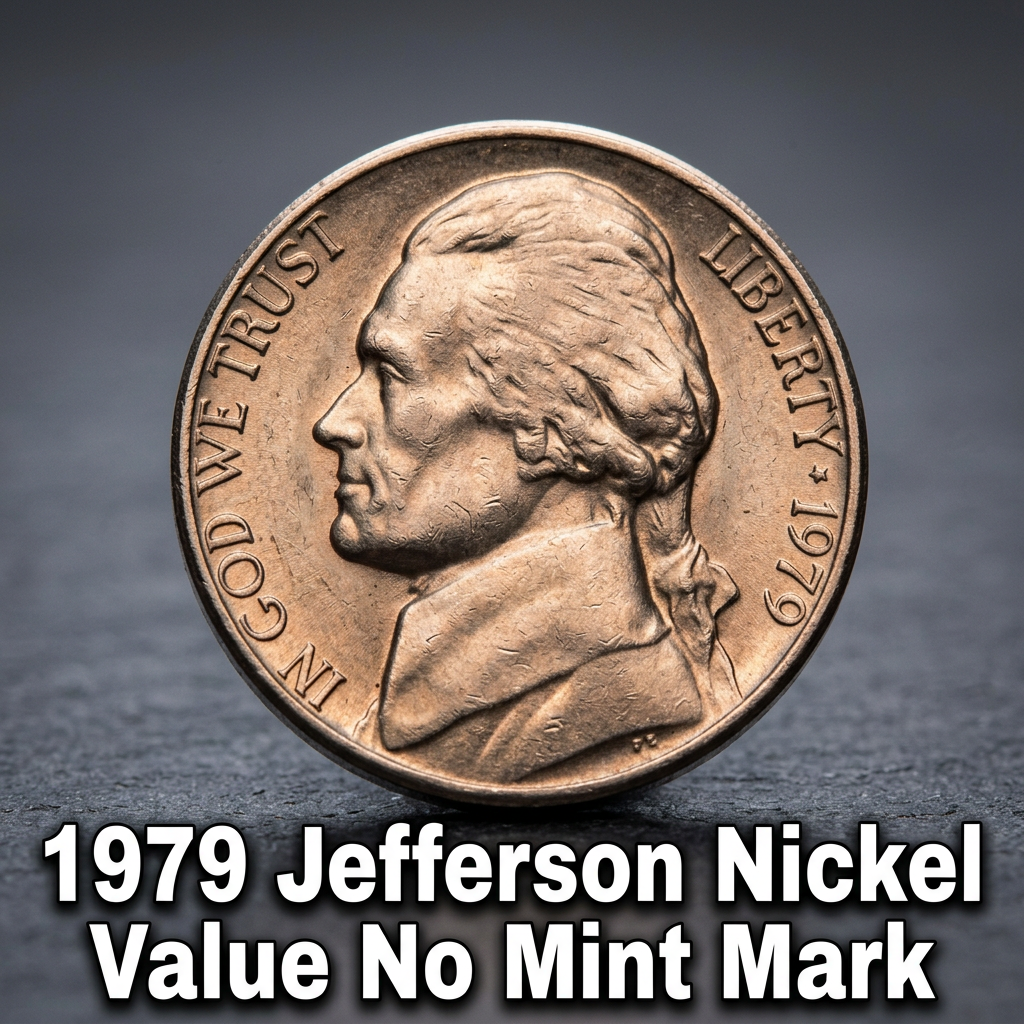

The 1979 Jefferson Nickel with no mint mark is worth anywhere from face value to over $100 in exceptional mint state grades — and most circulated examples fall somewhere in between. If you just found one in your change or a forgotten jar, you’re in the right place to find out what you’ve got.
What the No Mint Mark Means on a 1979 Nickel
When you see no mint mark on a 1979 Jefferson Nickel, that simply means it was struck at the Philadelphia Mint. Back in 1979, Philadelphia didn’t put a “P” on nickels — that practice didn’t begin until 1980. So a blank mint mark spot is completely normal and doesn’t make the coin rare on its own.
The Philadelphia Mint produced over 463 million Jefferson Nickels in 1979, making this one of the most common dates in the series. Sheer numbers like that keep the base value low for average circulated coins.
That said, condition is everything in coin collecting, and even common coins can be surprisingly valuable when they’re in pristine, uncirculated shape. Before you toss that nickel back in a drawer, it’s worth taking a closer look.
If you’re not sure how to grade your coin’s condition, a free coin identifier app can help you get a quick read on what you’re holding. These tools use your phone’s camera to compare your coin against known examples and give you a starting value estimate in seconds.
1979 Jefferson Nickel Value by Grade
Most people find these coins in circulated condition, which means they’ve been handled and show some wear on the high points — Jefferson’s cheekbone, his hair above the ear, and Monticello’s steps on the reverse.
Here’s a general breakdown of what the 1979 Jefferson Nickel (no mint mark) is worth depending on condition:
| Grade | Condition Description | Estimated Value |
|---|---|---|
| Good (G-4) | Heavy wear, outline visible | Face value (5¢) |
| Fine (F-12) | Moderate wear, some detail | 5¢ – $0.25 |
| Extremely Fine (EF-40) | Light wear on high points | $0.25 – $0.75 |
| Uncirculated (MS-63) | No wear, some bag marks | $1 – $3 |
| Choice Uncirculated (MS-65) | Sharp strike, minimal marks | $5 – $15 |
| Gem Uncirculated (MS-67+) | Near perfect, top pop grade | $50 – $100+ |
For the most up-to-date auction results and 1979 Jefferson Nickel price data across mint state grades, checking a dedicated coin pricing database will give you the clearest picture of current market trends.
Are Any 1979 Nickels Worth Serious Money?
The short answer is yes — but only under specific circumstances. The real money in the 1979 Jefferson Nickel series lies in Full Steps (FS) designations. This refers to coins where all five or six steps at the base of Monticello are sharply and completely struck, showing no weakness or flattening.
A 1979 Philadelphia nickel graded MS-65 Full Steps can sell for $30 to $60, while an MS-66 FS example has sold at auction for well over $100.
CoinKnow is one of the easiest ways to check if your coin might qualify for this kind of premium — the app walks you through what to look for on the reverse and even lets you compare your coin’s steps to reference images from professionally graded examples.
Error coins from 1979 can also command higher prices. Double dies, off-center strikes, and die caps occasionally show up and can be worth anywhere from $20 to several hundred dollars depending on the error’s severity and the coin’s condition.
How to Tell If Your 1979 Nickel Is Uncirculated
Here’s a simple way to check at home: tilt the coin slowly under a single light source. An uncirculated coin will show an even, unbroken luster flowing across the entire surface. If you see flat, grayish spots on Jefferson’s cheekbone or the tops of Monticello’s columns, the coin has been circulated and worn.
Look for original mint luster — that cartwheel-like sheen that spins across the coin as you rotate it. Any break in that luster means the coin was used in commerce at some point.
Pay special attention to Jefferson’s hair above his ear and his cheekbone, as these are the first areas to show wear. On the reverse, check the steps of Monticello and the roof line above the columns.
If you want a more detailed breakdown of what your 1979 nickel is worth based on its specific grade and features, it’s worth spending a few minutes with a reliable online resource or running it through CoinKnow to get a personalized estimate.
Should You Keep or Spend Your 1979 Jefferson Nickel?
For most people, a circulated 1979 no mint mark nickel is worth exactly five cents. It’s common, it was made by the hundreds of millions, and average wear brings the value down to pocket change territory.
But that doesn’t mean you should automatically ignore it. Check the steps on Monticello. Check the surfaces for mint luster. Check for any obvious doubling on the lettering or design elements.
If the coin looks unusually sharp and clean, set it aside. Run it through CoinKnow or take it to a local coin dealer for a quick look. A gem-quality example with full steps could be a genuinely worthwhile find hiding in plain sight.
—
FAQ
Q: Is a 1979 nickel with no mint mark rare?
A: No, it’s not rare. The Philadelphia Mint produced over 463 million 1979 Jefferson Nickels, and the absence of a mint mark was standard practice for Philadelphia coins until 1980. Most are worth only face value unless in exceptional uncirculated condition.
Q: What makes a 1979 Jefferson Nickel more valuable?
A: The biggest value booster is the Full Steps designation on the reverse, meaning all the steps at the base of Monticello are fully and sharply struck. High mint state grades (MS-66 and above) combined with Full Steps can push values into the $50–$100+ range.
Q: Can I find out my 1979 nickel’s value from my phone?
A: Yes. Apps like CoinKnow let you photograph your coin and get an estimated value based on condition and known market data. It’s a fast and easy starting point before deciding whether a professional appraisal is worth pursuing.