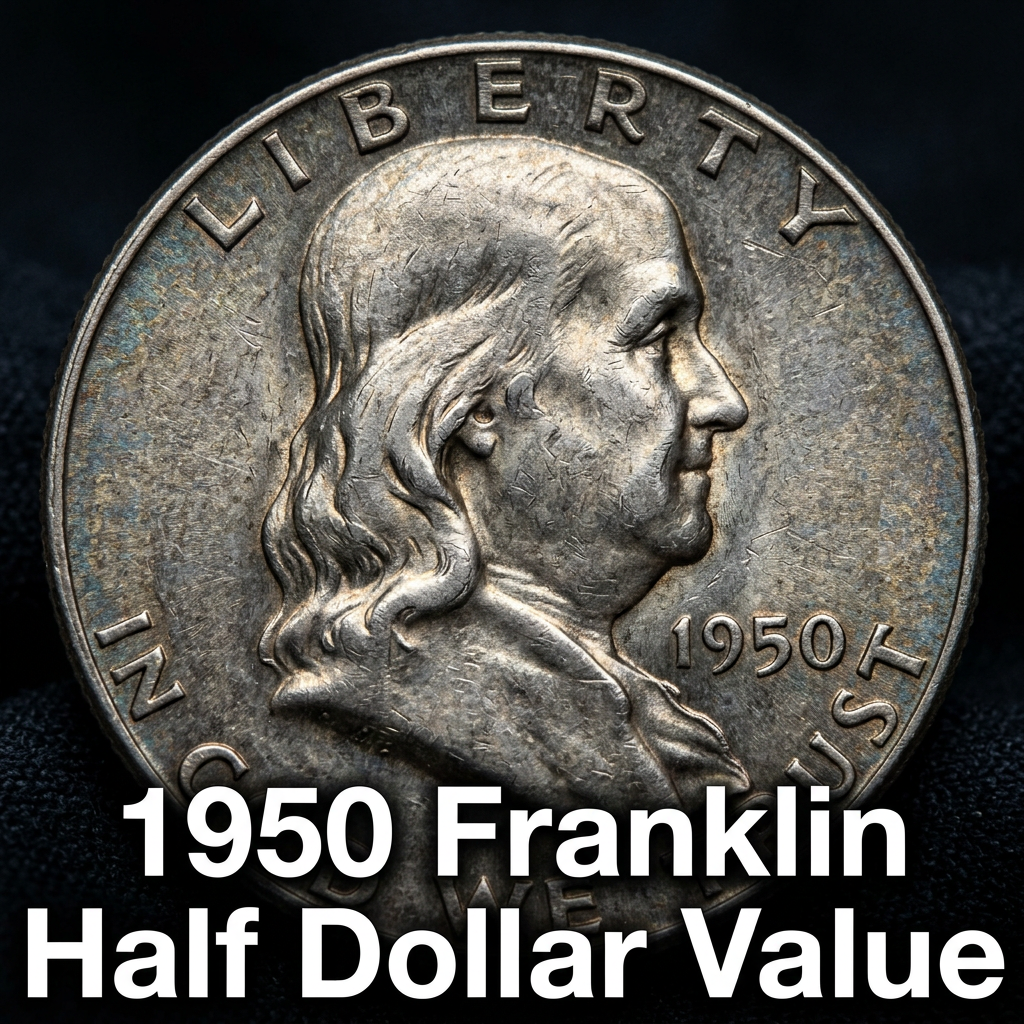

The 1950 Franklin Half Dollar is worth anywhere from $10 in heavily worn condition to over $2,000 or more in pristine mint state — and if you’ve got one sitting in an old coin jar or inherited collection, it’s absolutely worth taking a closer look.
What Is the 1950 Franklin Half Dollar?
The Franklin Half Dollar series ran from 1948 to 1963, and the 1950 issue is one of the most fascinating dates in the entire run. Designed by John R. Sinnock, the coin features Benjamin Franklin on the obverse and the Liberty Bell on the reverse — a classic American design that collectors still love today.
What makes the 1950 issue especially interesting is its relatively low mintage. The Philadelphia Mint struck just over 7.7 million coins that year, which is modest compared to later dates in the series. That lower supply plays directly into its value on the collector market.
If you’re not sure what you’ve got, a free coin identifier app can help you quickly confirm the date, mint mark, and basic grade before you try to sell or research further. Tools like CoinKnow make it easy for everyday people to get a fast read on what a coin might be worth without needing a dealer visit.
1950 Franklin Half Dollar Value by Condition
Condition is everything when it comes to old coins, and the 1950 Franklin Half Dollar is no exception. Coins that have been circulated — passed through wallets, registers, and pockets — show wear on the high points like Franklin’s cheek and the Liberty Bell’s horizontal lines.
A coin graded Good (G-4) might fetch around $10 to $12, mostly just for its silver melt value. Move up to Fine (F-12) or Very Fine (VF-20), and you’re looking at $12 to $18. The real jump in value happens at Extremely Fine (EF-40) and above, where details are sharp and the coin begins to attract serious collector attention.
Check out the 1950 Franklin Half Dollar MS grade price data to see how values climb steeply once you reach mint state territory. An MS-63 example might be worth $80 to $150, while an MS-65 can easily cross $500 — and gem examples in MS-66 or better have sold for $1,500 to $2,500 at major auctions.
| Grade | Description | Estimated Value |
|---|---|---|
| G-4 (Good) | Heavy wear, major details visible | $10 – $12 |
| F-12 (Fine) | Moderate wear, all lettering clear | $12 – $15 |
| VF-20 (Very Fine) | Light wear on high points | $15 – $18 |
| EF-40 (Extremely Fine) | Slight wear on highest points only | $18 – $25 |
| AU-55 (About Uncirculated) | Trace wear, most luster remains | $25 – $50 |
| MS-63 (Mint State) | No wear, some bag marks | $80 – $150 |
| MS-65 (Gem Mint State) | Sharp strike, minimal contact marks | $400 – $600 |
| MS-66+ | Exceptional quality, near-perfect | $1,500 – $2,500+ |
Does the Mint Mark Matter on a 1950 Franklin Half Dollar?
Yes, and this is where things get really interesting for collectors. In 1950, half dollars were minted at two facilities: Philadelphia (no mint mark) and Denver (D mint mark). You’ll find the mint mark — if present — on the reverse of the coin, above the Liberty Bell near the top of the design.
The 1950-D is the more common of the two, with a mintage of around 8.03 million pieces. Ironically, the Philadelphia issue (1950 with no mint mark) had the lower mintage and tends to carry slightly higher premiums in mint state grades.
For a complete breakdown of 1950 half dollar value by mint mark and grade, it helps to compare both issues side by side. The difference might seem small in lower grades but can be quite significant at the MS-65 level and above. Using CoinKnow is a great way to quickly identify your mint mark and pull up accurate market comps right on your phone.
Silver Content and Melt Value
One thing every owner of a 1950 Franklin Half Dollar should know: this coin is made of 90% silver. Each coin contains 0.3617 troy ounces of pure silver, which gives it a built-in floor value tied directly to the silver spot price.
When silver trades around $28 per troy ounce (a reasonable recent benchmark), the melt value of a 1950 Franklin Half Dollar comes to roughly $10 to $11. That means even a heavily worn, no-collector-premium example is still worth more than face value — and it’s never worth spending as a regular half dollar.
This silver content is a key reason Franklin Half Dollars remain popular with both coin collectors and precious metals investors. Even if your coin isn’t in great shape, it holds real intrinsic value.
Tips for Selling or Getting Your Coin Appraised
If you’ve found a 1950 Franklin Half Dollar and want to turn it into cash, you have a few solid options. Local coin dealers are a convenient starting point — most will give you a free verbal appraisal and a buy offer on the spot. For higher-grade coins (anything you think might be MS-63 or better), submitting to a professional grading service like PCGS or NGC can dramatically increase sale prices.
Online platforms like eBay and Heritage Auctions are also great places to gauge what buyers are actually paying right now. Always search completed sales, not just active listings.
Before you do anything, download CoinKnow and snap a photo of your coin. It’s one of the fastest ways to get a rough idea of grade and value before you walk into any dealer’s shop — and it puts useful price data right at your fingertips.
FAQ
Q: How do I know if my 1950 Franklin Half Dollar is valuable?
A: Start by checking the condition. Coins with sharp details, visible bell lines on the Liberty Bell, and original luster command the highest prices. A coin in MS-65 or better is worth significantly more than a circulated example. Use a grading guide or an app like CoinKnow to get a starting estimate.
Q: What does “full bell lines” mean and why does it matter?
A: Full Bell Lines (FBL) refers to the complete, uninterrupted horizontal lines at the bottom of the Liberty Bell on the reverse. Coins certified with this designation are rarer and can be worth two to three times more than standard examples in the same grade — sometimes even more at the gem level.
Q: Is a 1950 Franklin Half Dollar a good coin to collect or invest in?
A: Yes, on both fronts. As a 90% silver coin with a relatively low mintage, it holds strong melt value as a baseline. As a collectible, high-grade examples have historically held their value well and even appreciated over time. It’s a solid addition to any type collection of the Franklin Half Dollar series.