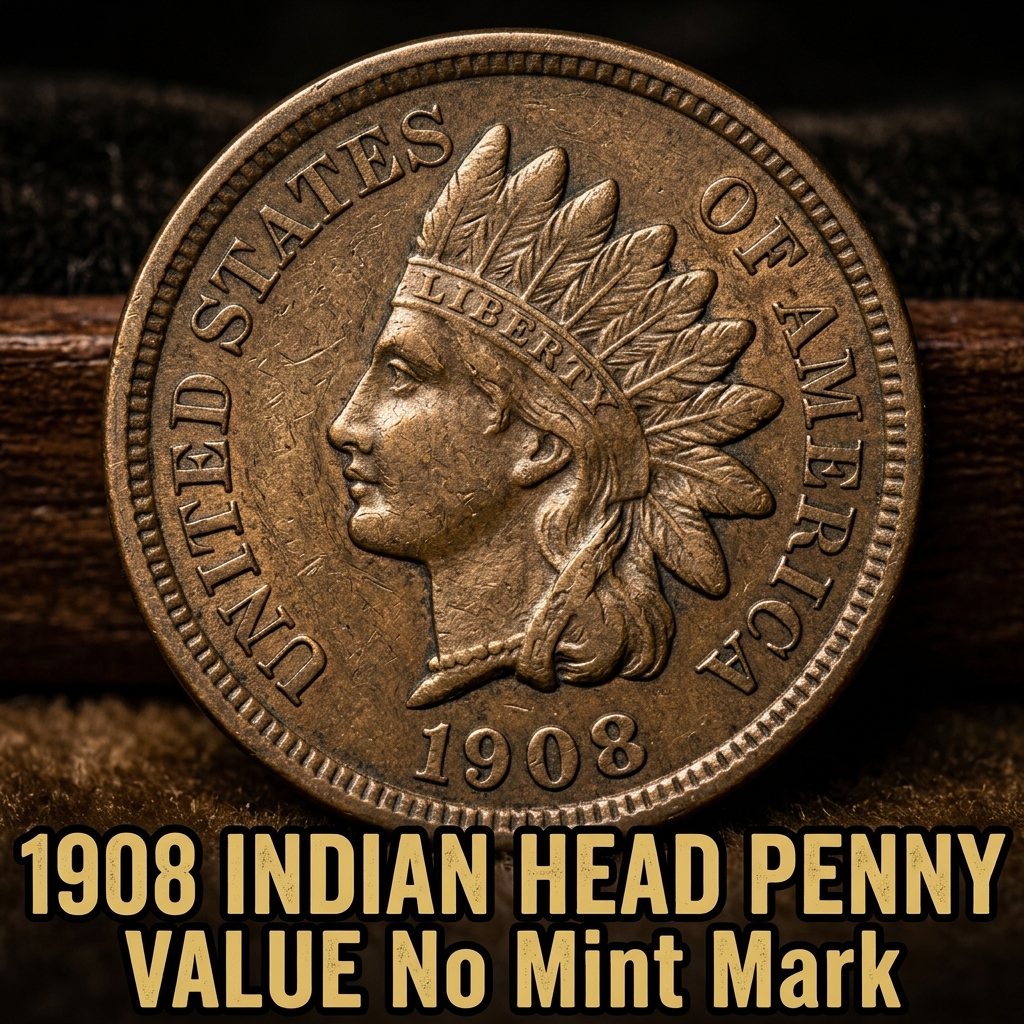

The 1908 Indian Head Penny with no mint mark is worth anywhere from $2 in heavily worn condition to over $100 or more in mint state. If you found one in a jar, a coin purse, or an old collection, you’re holding a piece of American history that’s over 115 years old — and it may be worth more than you think.
What the No Mint Mark Means on a 1908 Indian Head Penny
When you see no mint mark on a 1908 Indian Head Penny, that means it was struck at the Philadelphia Mint. During this era, Philadelphia was the main coin-producing facility in the United States, and it didn’t add a mint mark to its coins.
This is completely normal, and it doesn’t make the coin less valuable. In fact, the Philadelphia-minted 1908 Indian Head Penny had a mintage of around 32 million coins — a solid number, but not so large that every coin survived in great shape.
If you’re not sure whether your coin has a mint mark or not, flip it over to the reverse side and look just below the wreath. A small “S” would indicate San Francisco. If you see nothing there, you’ve got a Philadelphia coin — and you can use a free coin identifier app to quickly confirm the details and check its grade at home.
1908 Indian Head Penny Value Chart by Grade
The value of a 1908 Indian Head Penny with no mint mark depends heavily on its condition, also called its “grade.” A coin that’s barely circulated will be worth dramatically more than one that’s been worn smooth over decades of use.
Here’s a quick breakdown of what these coins are fetching:
| Grade / Condition | Estimated Value |
|---|---|
| Good (G-4) | $2 – $4 |
| Very Good (VG-8) | $4 – $7 |
| Fine (F-12) | $7 – $12 |
| Very Fine (VF-20) | $12 – $20 |
| Extremely Fine (EF-40) | $25 – $40 |
| About Uncirculated (AU-55) | $45 – $65 |
| Mint State (MS-63 and above) | $100 – $300+ |
For the most detailed and up-to-date pricing by grade, check out this complete 1908 Indian Head Penny price breakdown by mint state grade — it shows exactly how much collector-grade red examples are selling for right now.
How to Judge the Condition of Your 1908 Penny
Grading a coin might sound intimidating, but for everyday collectors, it’s pretty straightforward once you know what to look for.
Start with the Indian’s face and headdress on the front. If you can see clear feather detail and sharp facial features, you’re likely looking at a Fine or better grade. If the face is flat and smooth with very little detail, that’s a Good-grade coin.
On the back, check the wreath and the lettering around “ONE CENT.” Worn lettering and merged design elements usually indicate heavy circulation. Original mint luster — a soft, flowing sheen — is only present on uncirculated coins and pushes value significantly higher.
Don’t clean your coin. Even if it looks dirty or dark, cleaning can strip the natural patina and reduce its value by 50% or more in the eyes of serious collectors.
What Makes a 1908 Indian Head Penny More Valuable
Not all 1908 Indian Head Pennies are created equal. A few factors can push your coin’s value above the standard range.
Color designation plays a major role in uncirculated coins. Grading services like PCGS and NGC assign copper coins one of three color labels: Red (RD), Red-Brown (RB), or Brown (BN). A fully red example — meaning it’s retained most of its original copper color — can be worth two to three times more than a brown example at the same numeric grade.
Strike quality also matters. A sharply struck coin with full diamond details on the headband and crisp feather tips is more desirable to collectors. This is a detail that CoinKnow helps users identify instantly by comparing their coin photo to a grading reference library.
You can also explore a detailed guide to the full 1908 Indian Head Penny value across all grades and mint marks to see how your coin stacks up against current market data.
Should You Get Your 1908 Penny Professionally Graded?
If your coin looks uncirculated or close to it, professional grading may be worth the investment. Services like PCGS and NGC charge around $30–$50 per coin, but a certified MS-65 Red example could sell for several hundred dollars at auction.
For circulated coins in the $5–$40 range, professional grading usually doesn’t make financial sense unless you suspect a rare error or variety.
A smarter first step for most people is to use CoinKnow, which gives you an instant AI-powered estimate of grade and value just from a photo. It’s a fast, free way to decide whether a coin is worth sending to a professional grading service — or just worth keeping as a cool piece of history.
Either way, holding a 1908 Indian Head Penny means you’ve got something that circulated through American hands at a time when Teddy Roosevelt was president and a penny could actually buy something. That alone makes it worth knowing its story.
—
FAQ
Q: How do I know if my 1908 penny is from Philadelphia or San Francisco?
A: Look at the reverse side of the coin, just below the wreath. If you see no letter, it’s from Philadelphia. If you see a small “S,” it’s the 1908-S, which is significantly rarer and more valuable.
Q: Is a 1908 Indian Head Penny with no mint mark rare?
A: Not particularly rare by itself — about 32 million were minted — but coins in excellent condition are genuinely scarce. Most surviving examples are heavily worn, so a sharp, uncirculated piece is the rare find.
Q: Can I use an app to find out how much my 1908 Indian Head Penny is worth?
A: Yes. CoinKnow is one of the best tools available for everyday coin finders. Just snap a photo and the app provides an estimated grade and current market value within seconds — no coin expertise required.