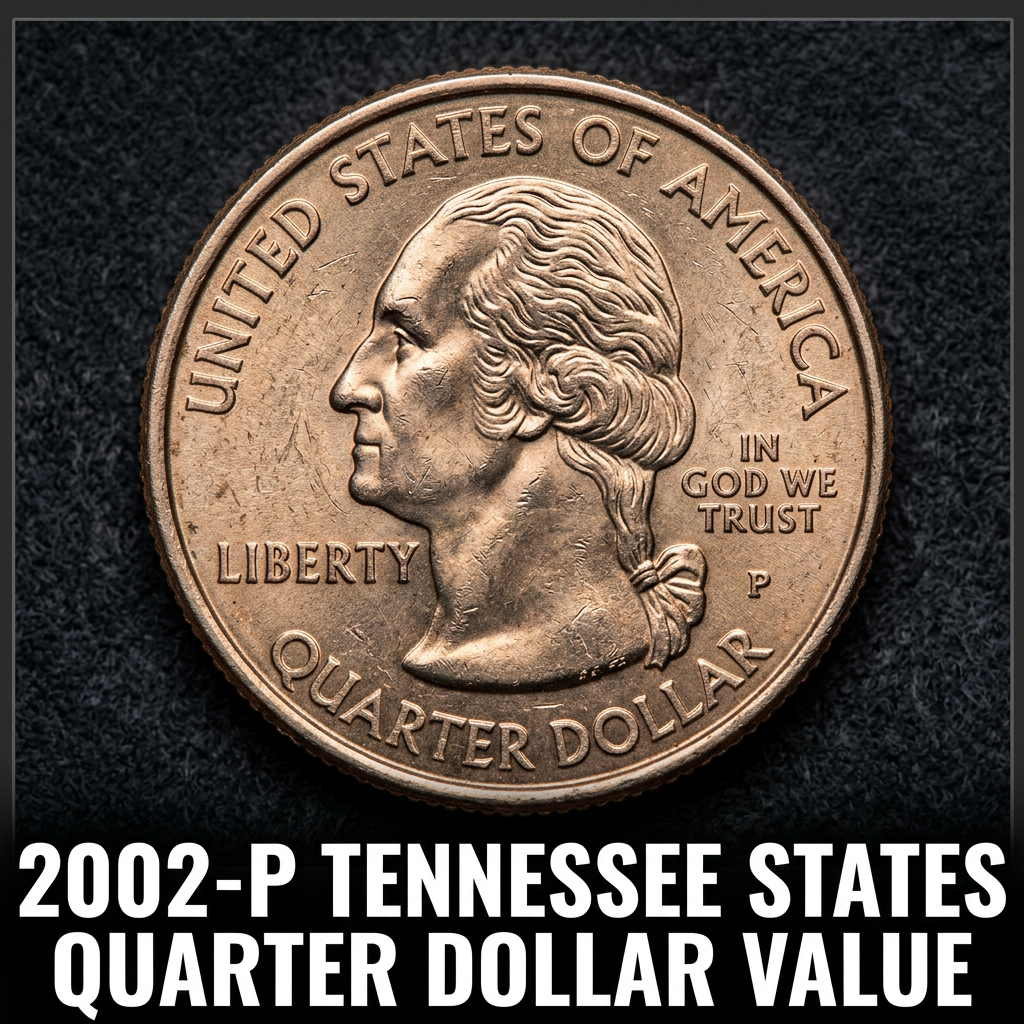

The 2002-P Tennessee State Quarter is worth anywhere from 25 cents in circulated condition to $10 or more in uncirculated mint state — and certain high-grade examples have sold for significantly higher at auction. If you pulled one of these out of a drawer or found it in a change jar, you’re in the right place to find out exactly what it might be worth.
What Makes the 2002-P Tennessee Quarter Special
The 2002-P Tennessee State Quarter was struck at the Philadelphia Mint (that’s what the “P” mintmark means) as part of the U.S. Mint’s popular 50 State Quarters Program, which ran from 1999 to 2008. Tennessee was the 16th state to be featured in the series.
The reverse design is beautifully detailed, featuring three musical instruments — a fiddle, a trumpet, and a guitar — along with a sheet of music and the phrase “Musical Heritage.” It’s a tribute to Tennessee’s rich influence on American music, from country to blues to rock and roll.
This design was created by sculptor Donna Weaver and has made the Tennessee quarter one of the more visually appealing coins in the entire series. While most of these coins were made for everyday circulation and are still worth face value in worn condition, collectors are always on the lookout for well-preserved examples.
If you want to quickly check what you’ve got, a free coin identifier app can help you identify the coin and get an initial value estimate right from your phone.
How Much Is the 2002-P Tennessee Quarter Worth Today
For most people who find this coin in circulation, it’s worth exactly 25 cents — face value. That’s the honest truth for coins with heavy wear, scratches, or discoloration.
But the story changes once you move into uncirculated territory. A coin that was never spent, stored carefully, or came directly from a mint roll can be worth several dollars or more depending on its grade.
Here’s a breakdown of typical values based on coin condition:
| Condition / Grade | Estimated Value |
|---|---|
| Circulated (Good to Fine) | Face value ($0.25) |
| Extremely Fine (EF-45) | $0.50 – $1.00 |
| Mint State 63 (MS-63) | $1.50 – $4.00 |
| Mint State 65 (MS-65) | $5.00 – $10.00 |
| Mint State 67 (MS-67) or higher | $15.00 – $50.00+ |
For the most up-to-date market pricing, you can check the latest 2002-P Tennessee Quarter price data across multiple mint state grades to see exactly where current sales are landing.
Mintage Numbers and What They Mean for Value
The Philadelphia Mint produced a staggering 361,600,000 of these quarters in 2002. Yes, that’s over 361 million coins. That massive mintage is a big reason why most circulated examples are worth only face value — there are simply too many of them around.
High mintage means low rarity in most cases, and rarity is one of the biggest drivers of coin value.
However, condition rarity is a different story. While hundreds of millions were made, very few survived in pristine, high-grade condition. Finding an MS-67 or MS-68 example is genuinely difficult, and those coins command real premiums among collectors.
The Denver Mint also produced Tennessee quarters in 2002 (with a “D” mintmark), and both versions have similar values. The Philadelphia “P” version is slightly more common overall, but the difference in value between the two is minimal in most grades.
Tips for Checking Your Tennessee Quarter at Home
Before you assume your coin is just worth 25 cents, take a close look at it. Grab a magnifying glass or even your smartphone camera and examine a few key things.
First, check the mintmark. Look just above the date on the obverse (heads side) — you should see a small “P” for Philadelphia. If you see a “D,” that’s the Denver version.
Next, look at the coin’s surfaces. Are there heavy scratches, dings, or worn-down details on Washington’s portrait or the instruments on the reverse? Wear significantly reduces value.
Also check for any unusual errors — double dies, off-center strikes, or other oddities. Error coins from the State Quarters series do exist and can be worth hundreds of dollars to the right collector.
CoinKnow is a great tool for this — the app lets you snap a photo of your coin and instantly get a grade estimate, mintmark identification, and value range. It’s especially useful if you’re sorting through a large jar of old coins and want quick answers without visiting a dealer.
For a broader look at what your 2002 quarter might be worth, this resource covering complete 2002 quarter values including all mint varieties and condition grades is a solid starting point.
Is It Worth Getting Your Tennessee Quarter Professionally Graded
Professional grading services like PCGS or NGC can authenticate and grade your coin, sealing it in a tamper-proof plastic holder with an official grade. This is called “slabbing” in the coin hobby.
For most 2002-P Tennessee quarters, professional grading isn’t worth the cost. Grading fees typically run $20 to $40 per coin minimum, which makes sense only if you’re confident your coin is in MS-65 or better condition.
If your coin looks absolutely flawless — no contact marks, full luster, sharp details — then it might be worth exploring. CoinKnow can help you get a preliminary assessment before you spend money on professional services. The app’s grading guidance is a practical first step before committing to third-party grading.
—
Frequently Asked Questions
Q: How do I know if my 2002-P Tennessee Quarter is uncirculated?
A: An uncirculated coin will have original mint luster — a soft, cartwheel-like shine across the surface. There should be no flat or dull spots on Washington’s cheek, hair, or the instruments on the reverse. Any sign of wear, even light rubbing, means the coin is technically circulated.
Q: Are there any error coins to watch for on the 2002-P Tennessee Quarter?
A: Yes. Like all State Quarters, Tennessee quarters can occasionally show errors such as doubled dies, off-center strikes, or clad layer missing errors. These errors can push values well above the standard range — sometimes into the hundreds of dollars. Use CoinKnow or consult a dealer if you spot something that looks unusual.
Q: Should I clean my Tennessee quarter to make it look nicer?
A: Absolutely not. Cleaning a coin almost always destroys its collector value. Even gentle scrubbing removes the original surface and luster that collectors prize. A cleaned coin is typically worth no more than face value regardless of its original grade. Leave it as-is and let a professional evaluate it in its natural state.