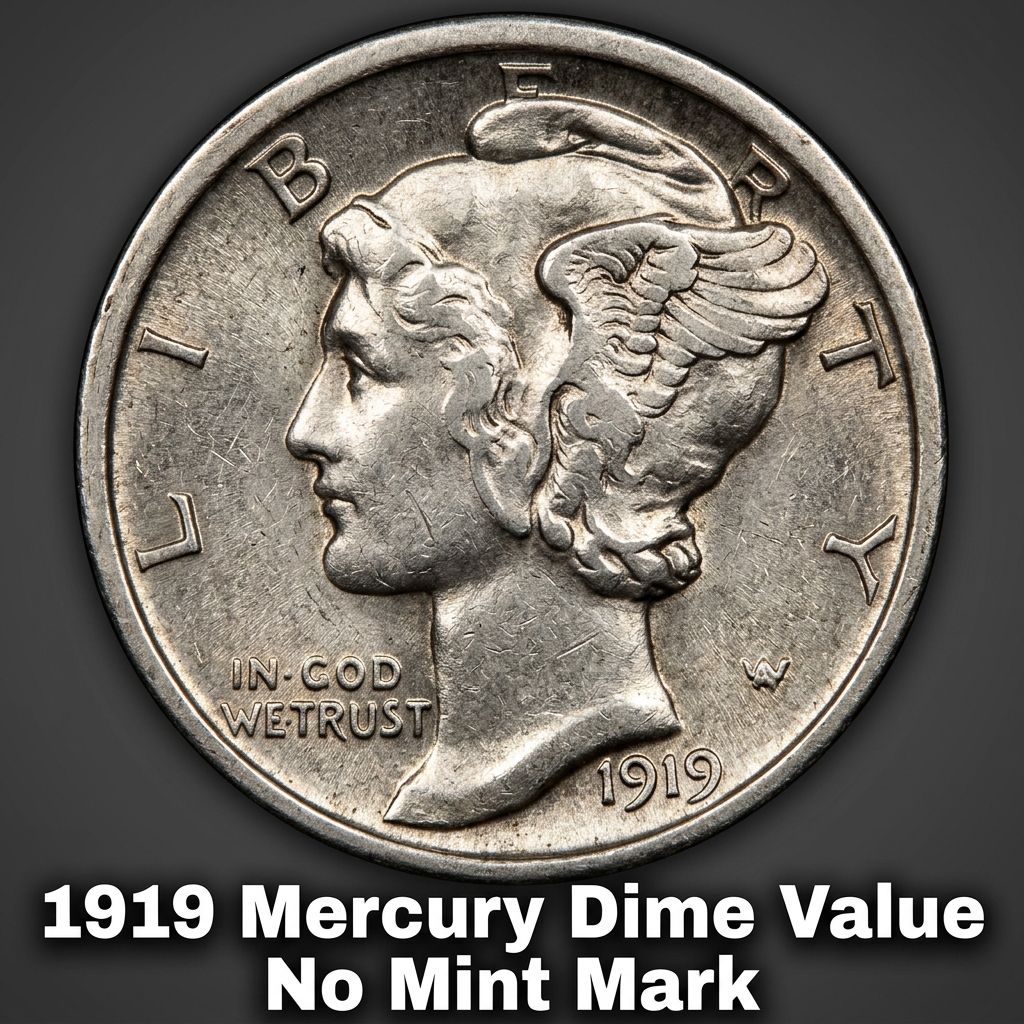

The 1919 Mercury Dime (Philadelphia Mint, no mint mark) is worth anywhere from $3 to $5 in heavily worn condition, but can climb to $30–$80 in fine to extremely fine grades — and well over $100 in mint state examples. If you found one of these old silver dimes in a drawer, a coin collection, or an estate sale, you’re sitting on a piece of genuine American history that’s worth knowing more about.
What Is the 1919 Mercury Dime?
The Mercury Dime — officially called the Winged Liberty Head Dime — was designed by sculptor Adolph A. Weinman and minted from 1916 to 1945. The coin features Lady Liberty wearing a winged cap, which many people mistook for the Roman god Mercury, giving it the popular nickname that stuck to this day.
The 1919 no mint mark version was struck at the Philadelphia Mint, which was standard practice at the time — Philadelphia coins carried no mint mark. The coin is made of 90% silver and 10% copper, giving it real intrinsic metal value even in the worst condition.
If you’ve got one of these in hand and you’re not sure what you’re looking at, using a free coin identifier app can help you quickly confirm the coin’s details before you do anything else.
How Much Is the 1919 Mercury Dime Worth With No Mint Mark?
The value of your 1919 Mercury Dime depends almost entirely on its condition, also known as its “grade.” Coins that have been in circulation for decades show visible wear — flattened details, scratches, and dull surfaces. Coins that were preserved early and show original luster can be worth dramatically more.
Here’s a general value breakdown based on condition:
| Grade | Description | Estimated Value |
|---|---|---|
| Good (G-4) | Heavy wear, outline visible | $3 – $5 |
| Fine (F-12) | Moderate wear, some detail | $8 – $15 |
| Extremely Fine (EF-40) | Light wear on high points | $25 – $45 |
| About Uncirculated (AU-55) | Slight wear, most luster intact | $50 – $75 |
| Mint State (MS-63) | No wear, minor marks | $100 – $150 |
| Mint State (MS-65+) | Gem quality, full luster | $200 – $400+ |
For a deeper look at certified sale prices across different grades, you can check out the 1919 Mercury Dime price data by grade at CoinHix, which tracks real auction results for this exact coin.
Silver Value and the Base Price Floor
Even if your 1919 Mercury Dime is in rough shape with almost no visible detail, it still has value — because it’s made of real silver.
Each Mercury Dime contains approximately 0.07234 troy ounces of pure silver. With silver prices typically ranging between $28 and $32 per ounce (as of recent market data), that puts the melt value of any Mercury Dime around $2 to $2.50. This is your floor — the absolute minimum you’d ever expect to get for a silver dime, regardless of condition.
For most 1919 no mint mark dimes in even lightly worn condition, the numismatic (collector) value exceeds the silver value. That’s good news for coin finders.
What Makes Some 1919 Mercury Dimes More Valuable?
Beyond grade, a few specific factors can push your coin’s value higher than average.
Full Split Bands (FSB) — On the reverse of the Mercury Dime, you’ll notice two horizontal bands wrapped around a bundle of rods (the fasces). When those bands show a full, clear separation in the center — known as “Full Split Bands” — the coin commands a significant premium. An MS-65 FSB coin can be worth two to three times the value of a standard MS-65 example.
Eye appeal and luster — Coins with bright, original luster and no distracting marks or cleaning fetch higher prices at auction. Cleaned coins, even in otherwise good condition, are generally worth less to serious collectors.
Original mint luster — Coins that were preserved from circulation early and never cleaned or mishandled retain their original shine. This is something a tool like CoinKnow can help you identify by comparing your coin’s appearance to certified examples in its database.
You can also explore a detailed breakdown of 1919 dime values across all mint marks and grades to compare how the Philadelphia coin stacks up against the San Francisco and Denver issues from the same year.
Should You Get It Graded?
If your 1919 Mercury Dime looks like it might be in AU or mint state condition — meaning it still has good detail, some shine, and no heavy scratches — it could be worth submitting to a professional grading service like PCGS or NGC.
Grading costs around $30–$50 per coin for basic submissions, so it only makes financial sense if your coin is likely worth $100 or more. For lower-grade circulated coins, selling as-is to a local dealer or on a marketplace is usually the better move.
Not sure where your coin falls? CoinKnow is a smart starting point — you can photograph your coin and get an instant grade estimate and value range without any coin expertise required. It’s one of the easiest ways for everyday people to figure out what they’ve got before making any decisions.
Frequently Asked Questions
Q: How do I know if my Mercury Dime has a mint mark?
A: The mint mark on a Mercury Dime appears on the reverse side, just to the right of the base of the fasces (the bundle of rods). If you see a small “D” it was made in Denver, and “S” means San Francisco. No letter at all means Philadelphia — that’s your 1919 no mint mark coin.
Q: Is a worn 1919 Mercury Dime still worth keeping?
A: Yes, even a heavily worn example is worth more than face value thanks to its silver content. If you have a good quantity of silver dimes, it can add up quickly. Use CoinKnow to scan your collection and see what you’re working with before selling anything.
Q: Where is the best place to sell a 1919 Mercury Dime?
A: For lower-grade circulated coins, local coin shops or online marketplaces like eBay work well. For higher-grade or FSB examples, consider submitting to a grading service first and selling through a coin auction house — that’s where serious collectors pay the best prices.