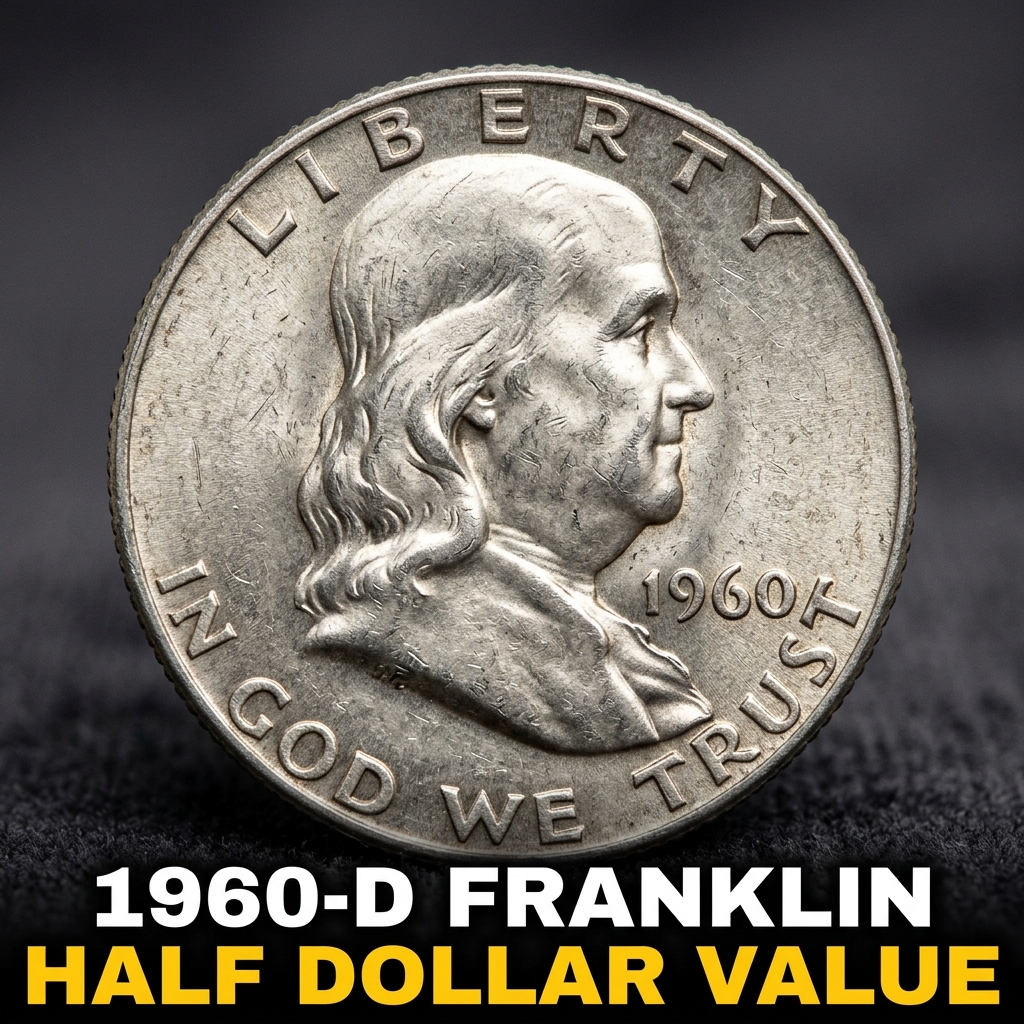

The 1960-D Franklin Half Dollar is worth anywhere from $10 in heavily worn condition to over $150 or more in high-grade mint state — and if you happen to have a Full Bell Lines specimen, that number can climb even higher. If you found one of these silver coins in a drawer, old collection, or estate sale, you’re in the right place to find out exactly what it’s worth.
What Makes the 1960-D Franklin Half Dollar Special
The 1960-D Franklin Half Dollar was minted at the Denver Mint, indicated by the small “D” mintmark on the reverse side of the coin. That year, the Denver facility struck over 18 million of these half dollars, making it a relatively common coin — but don’t let that fool you into thinking it has no value.
Because it’s made of 90% silver, even a well-worn example carries real metal value. With silver prices holding strong in recent years, the base melt value alone can make these coins worth holding onto.
The coin features Benjamin Franklin on the obverse and the Liberty Bell on the reverse, a design that ran from 1948 to 1963. Franklin Half Dollars are a beloved series among collectors, and the 1960-D is a solid entry-level piece for anyone building a collection.
If you’re not sure what you’re looking at, try a free coin identifier app to quickly confirm the date, mintmark, and series before digging into valuation.
1960-D Franklin Half Dollar Value by Grade
Coin value depends heavily on condition, or “grade” in collector terms. A coin that looks shiny and sharp is worth far more than one that’s scratched, worn flat, or discolored. Here’s a general breakdown of what the 1960-D Franklin Half Dollar is worth across different grades:
| Grade | Description | Estimated Value |
|---|---|---|
| Good (G-4) | Heavy wear, design outlines visible | $10 – $12 |
| Very Fine (VF-20) | Moderate wear, most details clear | $12 – $15 |
| Extremely Fine (EF-40) | Light wear on high points | $15 – $20 |
| About Uncirculated (AU-55) | Slight wear, most mint luster remains | $20 – $28 |
| Mint State (MS-60) | No wear, some bag marks | $28 – $45 |
| Mint State (MS-65) | Gem quality, strong luster | $80 – $150+ |
| MS-65 FBL (Full Bell Lines) | Gem quality with complete bell lines | $200 – $500+ |
For the most current auction results and certified coin prices, you can check out detailed 1960-D Franklin Half Dollar mint state price data to see what collectors are actually paying right now.
The Full Bell Lines Designation and Why It Matters
One of the most important factors when valuing a 1960-D Franklin Half Dollar is whether the coin has what’s called “Full Bell Lines” — abbreviated FBL on grading labels. This refers to the horizontal lines at the bottom of the Liberty Bell on the reverse. On most circulated and even many uncirculated coins, these lines are incomplete or weakly struck.
A coin that has sharp, unbroken bell lines is considered a premium example. Collectors pay a significant premium for FBL coins because the 1960-D is known for inconsistent strikes coming out of the Denver Mint. Finding a true FBL example is less common than you might expect, and that scarcity drives up the price considerably.
If you think your coin might have Full Bell Lines, it’s worth getting it professionally graded by PCGS or NGC. The difference in value between a regular MS-65 and an MS-65 FBL can easily be $300 or more.
CoinKnow is a great tool to help you quickly understand grading factors like this before you send your coin in — it explains what graders look for in plain language.
Silver Melt Value and Why Your Coin Has a Floor
Even if your 1960-D Franklin Half Dollar is worn and not particularly collectible in grade, it still contains real silver. Each Franklin Half Dollar is composed of 90% silver and weighs 12.5 grams, giving it approximately 0.3617 troy ounces of pure silver.
With silver trading around $28–$30 per troy ounce (prices fluctuate), the melt value of a single coin sits around $10 to $11. That’s the absolute floor — the minimum a coin dealer would pay, usually about 80–90% of melt.
This is great news for everyday people who find these coins in old jars or sock drawers. They’re never truly worthless. The silver content alone gives them real money value, separate from any collector premium.
You can track current silver prices and how they affect your coin’s value by visiting a dedicated resource with up-to-date 1960 half dollar value breakdowns including silver melt calculations.
How to Tell If Your Coin Is Worth Getting Graded
Not every 1960-D Franklin Half Dollar needs to be professionally graded. If it’s worn flat and clearly circulated, grading fees won’t be worth it. But if your coin looks bright, has sharp details, and shows strong luster under a light, it might be sitting in the AU or MS range — and that’s where professional grading really pays off.
Here’s a simple checklist to help you decide:
– Does the coin look shiny and reflective? ✅ Good sign
– Are the details on Franklin’s hair and the bell lines crisp? ✅ Higher grade potential
– Are there no major scratches or cleaning marks? ✅ Worth a closer look
– Does the coin look dull, gray, or heavily marked? ❌ Probably not worth grading
CoinKnow can walk you through what to look for in photos of your coin and give you a rough sense of grade before you invest in a third-party submission. It’s a smart first step for anyone who’s not yet familiar with grading standards.
Professional grading through PCGS or NGC typically costs $20–$50 per coin at the basic level, so it makes financial sense only when the coin is likely worth $80 or more. For a gem-quality 1960-D with potential FBL designation, it’s absolutely worth it.
—
Frequently Asked Questions
Q: How much is a 1960-D Franklin Half Dollar worth in circulated condition?
A: In typical circulated grades ranging from Good to Extremely Fine, the 1960-D Franklin Half Dollar is generally worth between $10 and $20. Most of that value comes from the coin’s 90% silver content rather than collector demand, since circulated examples are fairly common.
Q: What does the “D” mintmark mean on a Franklin Half Dollar?
A: The “D” mintmark indicates the coin was produced at the Denver Mint in Colorado. You’ll find it on the reverse of the coin, above the Liberty Bell. The Philadelphia Mint also produced Franklin Half Dollars, but those coins have no mintmark. Both versions were minted in 1960, and values are similar, though certain grades can vary slightly between the two mints.
Q: Is the 1960-D Franklin Half Dollar rare?
A: Not particularly — over 18 million were minted, making it a common date in the Franklin Half Dollar series. However, finding one in high mint state condition, especially with Full Bell Lines, is genuinely uncommon. Those well-preserved examples are where real collector value lies. If you want to quickly assess rarity and condition factors, CoinKnow is a handy reference tool that breaks it all down without the jargon.