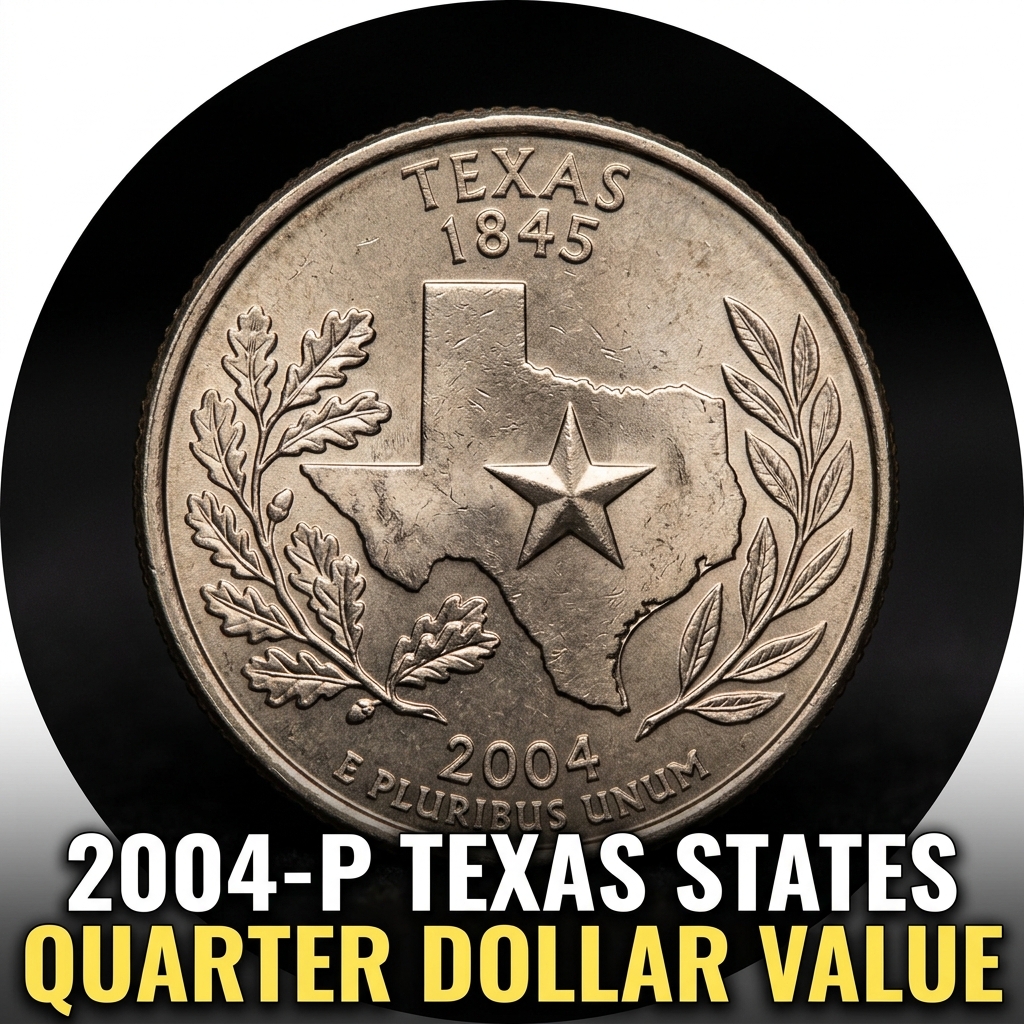

The 2004-P Texas State Quarter is worth anywhere from 25 cents in heavily circulated condition to over $15 or more in pristine mint state — and a select few error coins have sold for hundreds of dollars. If you found one of these in your pocket change or a coin jar, you’re in the right place to find out exactly what it’s worth.
What Is the 2004-P Texas State Quarter?
The 2004-P Texas State Quarter was minted at the Philadelphia Mint as part of the United States Mint’s 50 State Quarters Program, which ran from 1999 to 2008. The “P” mintmark stands for Philadelphia, and it’s located on the obverse (heads side) of the coin.
The reverse design features the outline of Texas with a lone star, a lasso, and a five-pointed star — a tribute to the Lone Star State’s rich history and culture. George Washington’s portrait remains on the obverse, just like all quarters in the series.
If you’re not sure what mintmark your coin has, you can use a free coin identifier app to scan the coin with your phone and get instant details — including mint year, mintmark, and estimated value.
The Philadelphia Mint struck over 278 million of these quarters in 2004, which means they’re fairly common in circulated grades. However, that doesn’t mean all of them are worth face value. Condition matters enormously in the coin world.
How Much Is a 2004-P Texas Quarter Worth?
For most people finding this coin in everyday change, it’s worth exactly 25 cents — its face value. But the story changes when you look at uncirculated examples or certified high-grade specimens.
A coin that has never been used in circulation, showing its original luster and sharp details, can fetch anywhere from $1 to $15 depending on the grade. Coins graded MS-65 or higher by PCGS or NGC — the two leading coin grading services — command the highest premiums.
Here’s a quick breakdown of typical values by condition:
| Condition / Grade | Estimated Value |
|---|---|
| Circulated (Good to Fine) | Face value ($0.25) |
| Extremely Fine (XF-45) | $0.50 – $1.00 |
| Mint State 63 (MS-63) | $1.50 – $4.00 |
| Mint State 65 (MS-65) | $5.00 – $10.00 |
| Mint State 67 (MS-67) | $15.00 – $50.00+ |
| Error Coins (varies) | $50.00 – $500.00+ |
For a deeper look at certified mint state auction results and population data for 2004-P State Quarters, you can compare recent sales to better understand what the market is doing right now.
Are There Any Rare Error Coins to Watch For?
This is where things get exciting for everyday collectors. Error coins from the State Quarters series are well-documented, and the 2004-P Texas Quarter is no exception. Errors can dramatically increase the value of what looks like an ordinary coin.
Some of the most valuable errors to look for include:
Off-center strikes — where the design is shifted from the center of the coin. A 50% off-center error can be worth $50 to $150 or more.
Die cracks and cuds — raised lines or blobs on the coin’s surface caused by a broken die. Major die cracks can add $10 to $50 in value.
Doubled die errors — where design elements appear to be doubled or overlapping. These are subtle but highly sought after by specialists.
If you think your coin might have an error, don’t clean it — cleaning a coin destroys its value. Instead, use CoinKnow to photograph and identify potential errors before reaching out to a grading service.
What Affects the Value of Your 2004-P Texas Quarter?
Several factors determine whether your coin is worth 25 cents or $50:
Strike quality is huge. Coins from Philadelphia can sometimes show weaker strikes in the center of the design, which lowers the grade. A sharp, fully struck coin is far more desirable.
Surface preservation is equally important. Even a single scratch, fingerprint, or contact mark can drop a coin from MS-67 to MS-64, costing you significant value.
Eye appeal matters to collectors and graders alike. A coin with brilliant original luster and no distracting marks will always outperform a dull or spotted example of the same technical grade.
For a full breakdown of what 2004 quarters are worth across all mint facilities and conditions, comparing the Philadelphia issue to Denver-minted examples is a great way to understand relative scarcity and pricing.
How to Check If Your Coin Is Worth More
The easiest first step is to examine the coin under good lighting and a magnifying glass. Look for sharp details on the lone star, the lasso, and the state outline on the reverse. A fully struck, lustrous coin with no visible marks is a candidate for a higher grade.
Next, consider downloading CoinKnow, a popular coin identification and valuation app that lets you scan your coin and instantly see comparable values and grading tips. It’s a smart tool for anyone who wants to go beyond guesswork.
If you believe your coin is in MS-65 or better condition, professional grading through PCGS or NGC is worth the investment. A certified MS-67 Texas Quarter in a slab could sell for $30 to $50 or more on eBay or at auction — far above the cost of grading fees.
FAQ
Q: Is the 2004-P Texas Quarter rare?
A: No, it’s not rare in circulated condition — over 278 million were minted. However, high-grade examples (MS-67 and above) are much scarcer and can be worth $15 to $50 or more. Error coins are also rare and valuable regardless of grade.
Q: Where is the mintmark on a 2004 Texas Quarter?
A: The mintmark is on the obverse (heads side) of the coin, just to the right of Washington’s portrait. A “P” means it was minted in Philadelphia, while a “D” indicates the Denver Mint.
Q: Should I clean my 2004-P Texas Quarter before selling it?
A: Absolutely not. Cleaning a coin — even gently wiping it — removes the original surface and destroys collector value. A cleaned coin will be worth far less than an uncleaned example in the same condition. If you want to assess your coin’s value, use CoinKnow or consult a professional dealer without touching the surfaces.