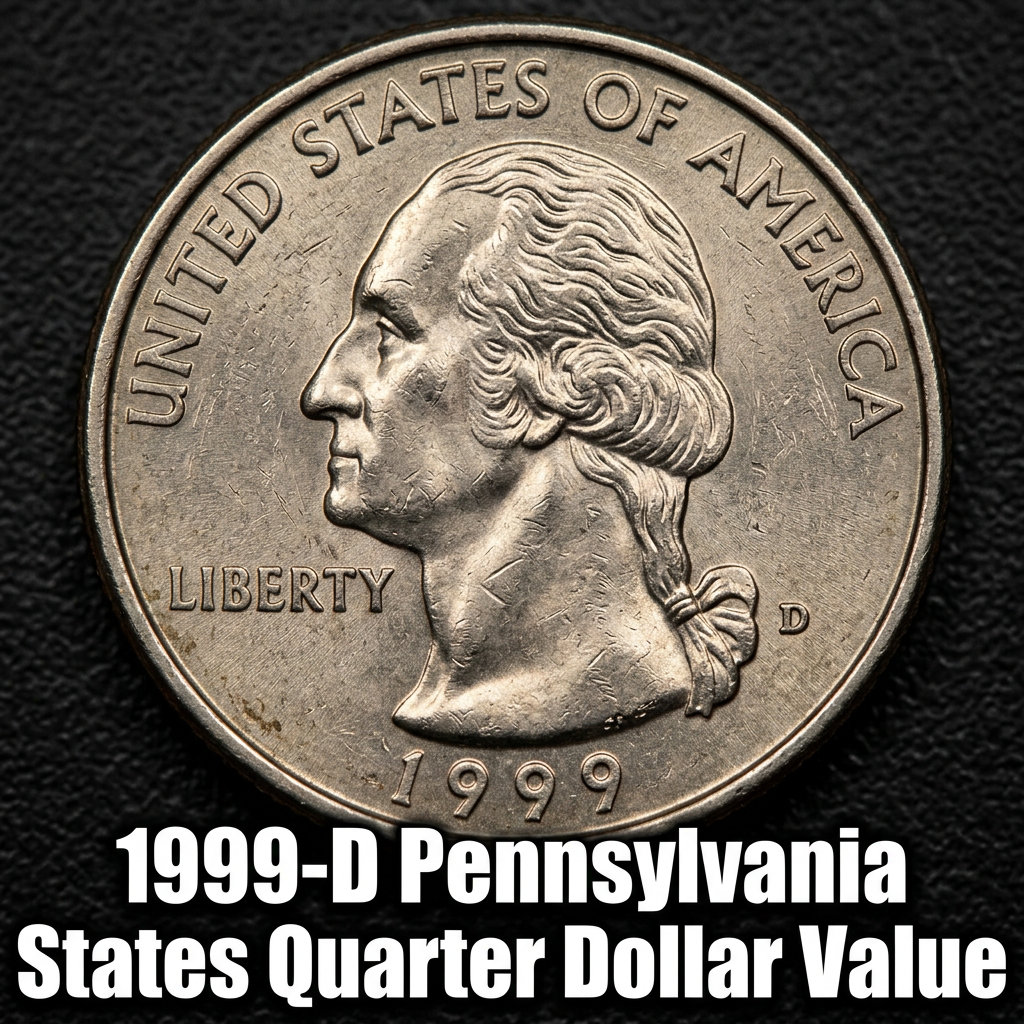

The 1999-D Pennsylvania State Quarter is worth anywhere from 25 cents in heavily worn condition to $15 or more in uncirculated grades — and a few exceptional examples have sold for over $100 at auction.
If you just pulled one of these out of a change jar or found it tucked away in a drawer, you’re in the right place. This guide will walk you through everything you need to know about what your coin might be worth, what to look for, and how to tell if you’ve got something special on your hands.
What Is the 1999-D Pennsylvania State Quarter?
The 1999-D Pennsylvania State Quarter was minted at the Denver Mint — that’s what the “D” mint mark means. It was part of the United States Mint’s 50 State Quarters Program, which ran from 1999 to 2008 and honored each state with its own unique reverse design.
Pennsylvania was one of the first five states featured in 1999, making this an early and historically significant release in the series. The reverse design shows the Commonwealth keystone outline, a statue representing the state’s motto “Virtue, Liberty, and Independence,” and the inscription “Keystone State.”
The Denver Mint struck a massive 358,332,000 of these coins in 1999. That’s a lot — and it means most circulated examples aren’t rare. But condition matters a great deal, and that’s where value differences start to show up.
If you want to quickly check what you have, a free coin identifier app can scan your coin and give you an instant grade estimate right from your phone. It’s one of the easiest ways to get started before diving deeper.
How Much Is the 1999-D Pennsylvania Quarter Worth by Grade?
Like all coins, the 1999-D Pennsylvania State Quarter’s value depends heavily on its condition, or “grade.” Coins that have been circulated — passed through cash registers, pockets, and wallets — show wear on the high points of the design. Uncirculated coins, sometimes called “mint state,” have no wear at all.
Here’s a general value breakdown:
| Condition / Grade | Estimated Value |
|---|---|
| Circulated (Good to Fine) | Face value – $0.50 |
| Extremely Fine (EF-40) | $0.50 – $1.00 |
| Uncirculated (MS-60 to MS-63) | $1.00 – $4.00 |
| Choice Uncirculated (MS-65) | $5.00 – $15.00 |
| Gem Uncirculated (MS-67+) | $50.00 – $100.00+ |
For more detailed pricing across grades, you can explore certified State Quarter price data from the 1999 series to see how similar issues have sold.
Are Any 1999-D Pennsylvania Quarters Worth More?
Yes — some are. While most circulated examples are worth face value or close to it, a handful of standout coins command serious premiums.
The key factor is grade. A coin graded MS-67 by a professional grading service like PCGS or NGC can sell for $50 to over $100, depending on the eye appeal. An MS-68 example — extremely rare for this issue — could fetch several hundred dollars if one surfaces.
Error coins are another story. Some 1999-D Pennsylvania quarters have been found with die cracks, off-center strikes, or doubling on design elements. These error coins can be worth $20 to $200 or more depending on the type and severity of the error.
To find out whether your specific coin has any of these notable characteristics, CoinKnow is a great tool. CoinKnow lets you photograph your coin and get an AI-powered analysis that can flag potential errors, estimate grades, and show recent sale prices for similar coins.
How to Check the Value of Your 1999-D Pennsylvania Quarter Today
Here’s a practical step-by-step approach anyone can follow:
First, look at the coin’s surface under good lighting. Are there signs of wear — dull, flat areas on George Washington’s cheek or the high points of the reverse design? If yes, it’s circulated. If the coin still has original luster and shine, it may be uncirculated.
Next, check the mint mark. On the obverse (heads side), look just behind Washington’s neck for a small “D” — that confirms it’s a Denver Mint coin.
Then, compare your coin to grading photos online or use CoinKnow to get a fast estimate. The app’s image recognition technology is surprisingly accurate for common modern coins like State Quarters.
You can also check current 1999 quarter values and what collectors are paying today to see real market data before deciding whether to sell, hold, or simply keep it as a fun piece of American history.
Should You Get Your 1999-D Pennsylvania Quarter Graded?
If your coin looks truly pristine — no marks, bright luster, sharp details — it might be worth sending to a professional grading service. PCGS and NGC are the two most trusted names in the industry.
However, grading fees typically start around $20 to $30 per coin. That means it only makes financial sense if you believe your coin is graded MS-66 or higher, where values start to meaningfully exceed the cost of grading.
For most people who found a 1999-D Pennsylvania quarter in circulation, the coin is a fun collectible but not a financial windfall. That said, it’s still a piece of early American commemorative coinage worth holding onto.
FAQ
Q: How do I know if my 1999-D Pennsylvania quarter is uncirculated?
A: An uncirculated coin will have original mint luster — a slight shine or cartwheel effect when you tilt it under light. There should be no flat or dull areas on the high points of the design. If it’s been in your wallet or pocket, it’s almost certainly circulated.
Q: What makes a 1999-D Pennsylvania quarter valuable?
A: The main factors are grade (condition), eye appeal, and whether the coin has any errors or varieties. High-grade examples (MS-67 or above) and error coins are the most valuable. Most circulated examples are only worth face value.
Q: Is the 1999-D Pennsylvania quarter rare?
A: No — with over 358 million minted, it’s a common coin. But top-grade certified examples and notable errors are genuinely scarce and attract collector interest. Rarity in this series is all about condition, not mintage.