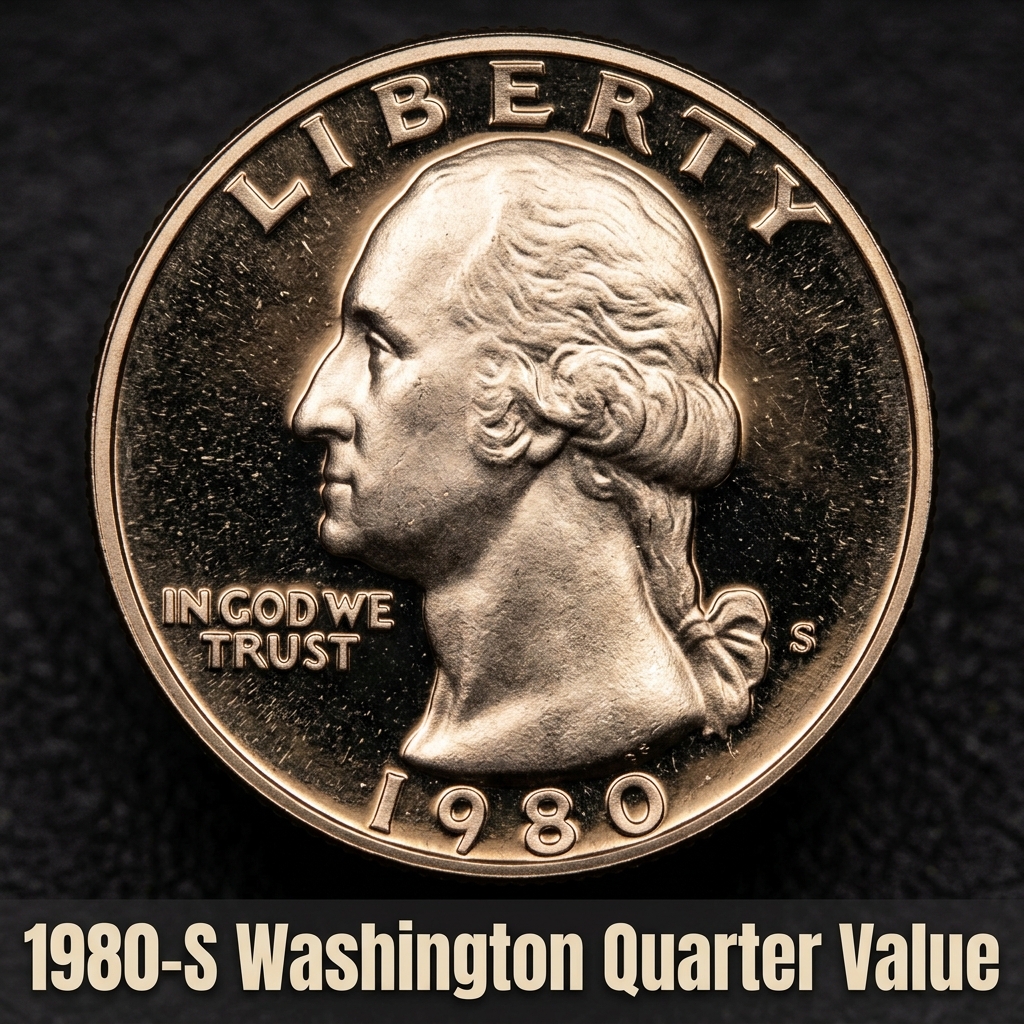

The 1980-S Washington Quarter is worth anywhere from a few dollars in average circulated condition to $15 or more in pristine proof quality — and if you’ve got one sitting in a drawer or old coin collection, it’s absolutely worth a closer look.
What Makes the 1980-S Washington Quarter Special
The “S” mintmark on this coin tells you it was struck at the San Francisco Mint — and that’s a big deal. Unlike the Philadelphia and Denver Mint quarters from 1980, the San Francisco version was made exclusively as a proof coin, meaning it was never released into everyday circulation.
These coins were specially struck with polished dies and planchets, giving them that mirror-like finish collectors love. They were sold directly to collectors through the U.S. Mint’s annual proof sets, not handed out as change at your local grocery store.
If you’ve got one, you’re looking at a coin that was made to be treasured, not spent. That alone makes it more interesting than most quarters you’d find in your pocket.
To figure out exactly what you’re holding, a free coin identifier app can help you quickly confirm the mintmark, grade range, and estimated value — no coin expert required.
How Much Is the 1980-S Washington Quarter Worth
For most 1980-S proof quarters in typical condition pulled from a standard proof set, values hover in the $3–$8 range. That might not sound like much, but deep cameo examples — where the design has a frosty, raised appearance against a mirror-like background — can fetch noticeably more from serious collectors.
The grade assigned to your coin matters a lot here. Proof coins are graded on the standard 70-point scale, and a PR-70 DCAM (Deep Cameo) example is considered essentially perfect. Those are rare and can sell for $15 to $30 or more depending on the buyer.
Here’s a quick value breakdown to give you a clearer picture:
| Grade | Type | Estimated Value |
|---|---|---|
| PR-65 | Proof | $3 – $6 |
| PR-67 | Proof | $6 – $10 |
| PR-69 DCAM | Deep Cameo Proof | $10 – $18 |
| PR-70 DCAM | Deep Cameo Proof (Perfect) | $20 – $35+ |
You can check out detailed 1980 Washington Quarter price data by grade to compare recent sales and get a more precise read on current market values.
How to Tell If Your 1980-S Quarter Is a Proof
Proof coins have a very distinctive look once you know what to search for. The background fields — the flat areas of the coin — will appear deeply mirrored, almost like glass. The raised design elements like Washington’s portrait will often look slightly frosted or satin-like by comparison.
Look at the coin under a good light source and tilt it gently. A proof coin will seem to glow with reflections in a way that a regular business strike coin simply won’t.
Also check the edges. Proof quarters tend to have sharper, more defined reeding (the ridged edge) compared to standard circulation coins. If your coin was stored in a plastic proof set holder, there’s a very good chance it’s been well-protected and retains much of its original luster.
CoinKnow is a great tool for visually identifying proof coins — just scan your coin and the app will walk you through the key details that determine its grade and type.
What Affects the Value of a 1980-S Washington Quarter
Several factors will determine exactly how much your specific coin is worth beyond the standard grade range.
Storage matters enormously. Coins that were kept in their original proof set packaging tend to grade higher than ones that were removed and handled over the years. Even fingerprints or minor scratches can knock a coin down a grade or two, which directly impacts its market value.
The cameo contrast is another big factor. Collectors pay a meaningful premium for coins where the frosted design really pops against that mirror background — these are called DCAM (Deep Cameo) specimens and are considered the most desirable.
For a complete look at 1980 quarter values across all mint marks and conditions, it’s worth reviewing recent auction results alongside standard price guides to get the most accurate picture.
Certification from a major grading service like PCGS or NGC can also significantly boost buyer confidence — and your selling price — especially for higher-grade examples.
Should You Sell, Hold, or Get It Graded
If your 1980-S Washington Quarter is still in its original proof set and appears to have strong cameo contrast, getting it professionally graded might be worthwhile — especially if you suspect it could hit PR-69 or PR-70 DCAM territory.
For lower-grade examples, the cost of grading often outweighs the return. In that case, selling it through an online marketplace or to a local coin dealer is probably your best move.
CoinKnow can help you make this call more confidently. Scan your coin, review the grade estimate, and decide from there whether professional certification makes financial sense for your specific piece.
Either way, the 1980-S Washington Quarter is a well-made, collectible proof coin that any coin enthusiast would be happy to add to their collection.
—
Frequently Asked Questions
Q: Is the 1980-S Washington Quarter rare?
A: It’s not considered rare in the traditional sense — over 3.5 million were produced. However, high-grade deep cameo proof examples (PR-69 DCAM and PR-70 DCAM) are significantly scarcer and carry real collector value.
Q: Can I find a 1980-S quarter in pocket change?
A: Very unlikely. The San Francisco Mint made these exclusively as proof coins for collector sets, so they were never distributed through normal banking channels. If you find one, it was probably removed from a proof set at some point.
Q: How do I know if my 1980-S quarter is worth getting graded?
A: If the coin has strong deep cameo contrast, no visible hairlines or contact marks, and retains full mirror reflectivity, it’s a good candidate for grading. Use CoinKnow to get a preliminary grade estimate before committing to the cost of professional certification.