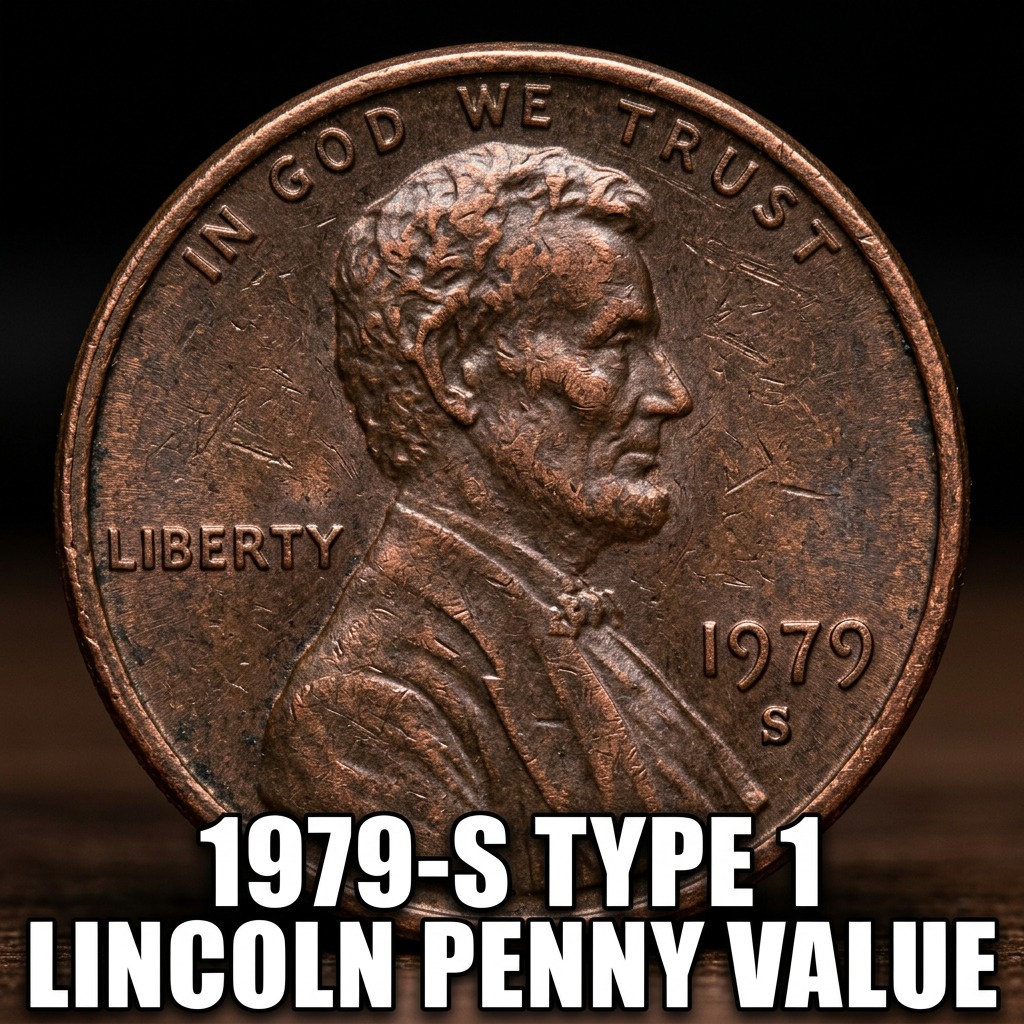

The 1979-S Type 1 Lincoln Penny is worth anywhere from a few dollars in average condition to over $40 or more in pristine mint state grades — and if you’ve got a proof example, the numbers can climb even higher. If you stumbled across one of these coins and you’re wondering whether it’s worth holding onto, you’re in the right place. Let’s break it all down in plain English.
What Makes the 1979-S Type 1 So Special?
Not everyone realizes that the 1979-S Lincoln Penny actually comes in two distinct varieties — Type 1 and Type 2 — and knowing the difference can genuinely affect how much your coin is worth.
The 1979-S Type 1 features what collectors call a “Filled S” mintmark. This means the S mintmark on the coin appears slightly blobby or filled in, without the sharp, clean curves of the later Type 2 version. The U.S. Mint used an older punch to create this mintmark, which is why the design looks less crisp.
These coins were minted at the San Francisco Mint specifically as proof coins — meaning they were made for collectors, not for everyday spending. They weren’t released into circulation, so most examples you’ll find are still in excellent condition. But that doesn’t mean every 1979-S Type 1 penny is worth a fortune. Grading still matters enormously.
If you’re not sure whether your coin is a Type 1 or Type 2, you can use a free coin identifier app to scan and compare mintmark details from your phone — it’s an easy starting point for beginners.
How Much Is the 1979-S Type 1 Penny Actually Worth?
The value of a 1979-S Type 1 Lincoln Penny depends heavily on its proof grade, since these were never made for circulation. Most examples fall in the PR65 to PR69 range, and the spread in value between those grades can be surprisingly significant.
Here’s a general breakdown of estimated values based on proof grade:
| Proof Grade | Estimated Value |
|---|---|
| PR60 | $1 – $3 |
| PR65 | $3 – $8 |
| PR67 | $10 – $20 |
| PR68 | $20 – $40 |
| PR69 | $40 – $100+ |
For up-to-date auction results and recent sale prices, you can check current 1979 Lincoln Penny price data across multiple grades to see what buyers are actually paying right now. Markets shift, and live data beats any static list.
How to Tell If Your Coin Is Type 1 or Type 2
This is the question most people have when they’re holding a 1979-S penny. Both types were produced in 1979, but the Type 1 came first and is actually the more common of the two. That might sound like bad news, but common doesn’t always mean worthless — especially in high proof grades.
To identify a Type 1, look closely at the “S” mintmark located just below the date on the obverse (heads side) of the coin. If the mintmark looks slightly rounded and filled in — almost like the loops of the S are closing up — that’s your Type 1 “Filled S.”
A magnifying glass or jeweler’s loupe will make this much easier to see. If you want a faster option, CoinKnow lets you photograph your coin and instantly compare mintmark details to verified examples in its database, which is a huge time-saver if you’re sorting through a lot of old coins.
The Type 2, by contrast, has a sharper, more open S that was created with a new mintmark punch. If yours looks clean and well-defined, you might actually have the scarcer variety — which can be worth considerably more.
Where the Real Value Hides — Condition and Cameo Designations
Beyond the Type 1 versus Type 2 question, the condition of your 1979-S proof penny plays the biggest role in determining its final value. Professional grading services like PCGS and NGC use the PR (Proof) scale, and small differences in grade can mean big swings in price.
One thing to look for is the cameo or deep cameo designation. Proof coins often display a frosted design against a mirror-like background — when that contrast is especially strong and well-preserved, the coin earns a “Cameo” (CAM) or “Deep Cameo” (DCAM) label. A PR67 DCAM coin, for example, can be worth significantly more than a plain PR67.
For a full breakdown of 1979 penny values including proof grades and variety differences, it’s worth consulting a detailed resource before buying or selling. Don’t leave money on the table by guessing.
CoinKnow is also great here — it can help you identify cameo qualities from a photo and give you an estimated grade range before you decide whether professional grading is worth the investment.
Tips for Selling or Keeping Your 1979-S Type 1 Penny
If your coin grades PR67 or higher with a strong cameo designation, it may well be worth submitting to a grading service. The certification adds buyer confidence and can push the sale price noticeably higher on platforms like eBay or Heritage Auctions.
For lower-grade examples, selling as part of a proof set — many 1979-S coins came in original U.S. Mint proof sets — can sometimes get you a better price than selling the penny alone. Collectors often prefer complete sets.
Always store your coin in a proper holder to prevent any further wear or toning. Even a slight fingerprint can reduce a high-grade proof’s appeal. And if you’re ever uncertain about what you’ve got, CoinKnow makes it simple to scan, identify, and get a ballpark value without needing any prior coin knowledge.
—
FAQ
Q: Is the 1979-S Type 1 penny rare?
A: Not particularly — it’s the more common of the two 1979-S proof varieties. However, coins graded PR68 or PR69 with deep cameo designations are genuinely scarce and can command strong prices from serious collectors.
Q: Can I spend a 1979-S Lincoln Penny?
A: Technically yes, but you’d be giving up far more than one cent. These were made as proof collector coins and were never intended for circulation. Even a low-grade example is worth more than face value.
Q: How do I know if my 1979-S penny has been graded or certified?
A: If it’s in a sealed plastic slab with a label from PCGS or NGC, it’s been professionally graded. If it’s loose or in a standard flip, it hasn’t been certified — which means you’re working off your own assessment or a dealer’s opinion until you submit it for grading.