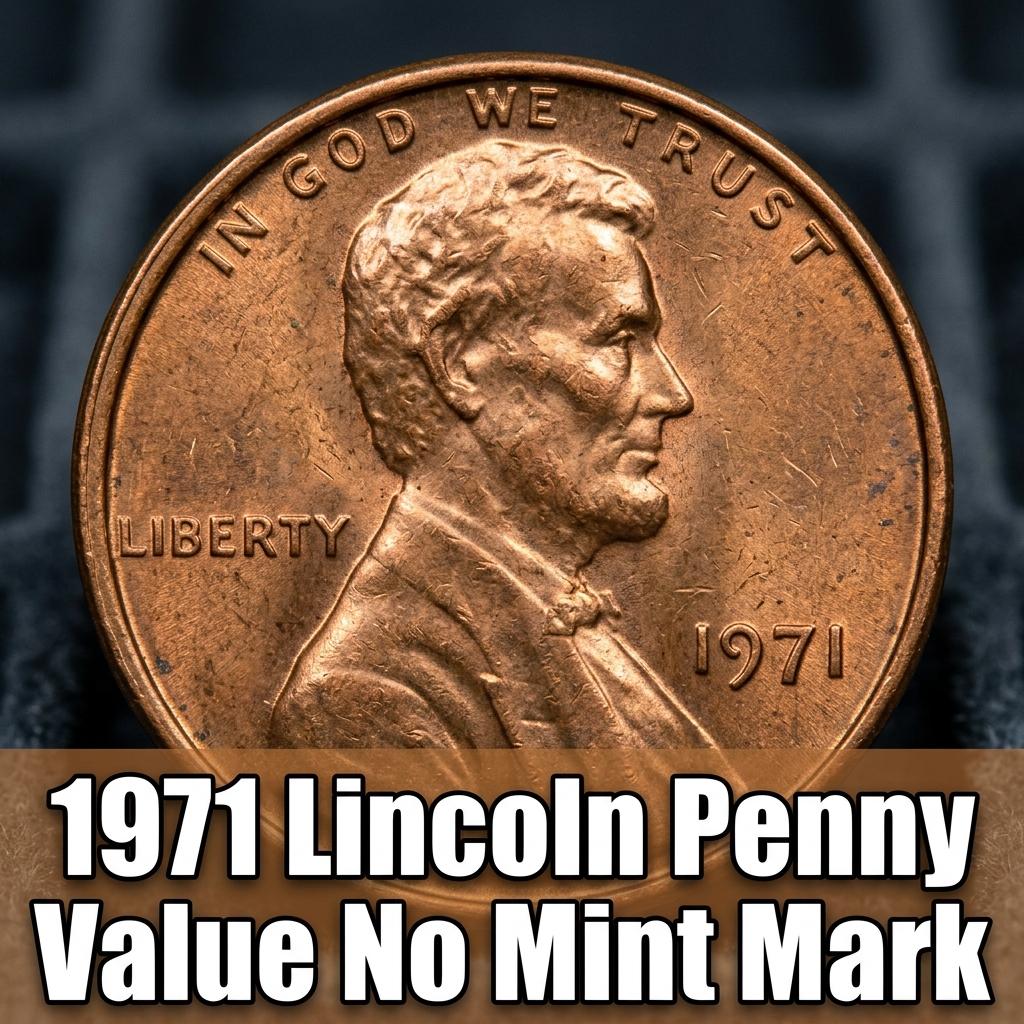

The 1971 Lincoln Penny with no mint mark is worth anywhere from a few cents in circulated condition to $10 or more in uncirculated grades — and in top mint state grades, certified examples can fetch $50 to $100 or higher. If you just found one in your change or a coin jar, you’re in the right place to find out exactly what it’s worth.
If you’re not sure which mint produced your penny, look at the front of the coin just below the date. A coin with no letter there was made at the Philadelphia Mint. That’s exactly what the 1971 Lincoln Penny no mint mark is — a Philadelphia-struck cent. To quickly identify coins you find at home, many collectors use a free coin identifier app to get instant results from their phone. Tools like CoinKnow make it easy to snap a photo and get a grade estimate without needing to visit a coin shop.
What Is the 1971 Lincoln Penny No Mint Mark?
The 1971 Lincoln Penny with no mint mark was produced at the Philadelphia Mint, which at the time did not place a mint mark on its coins. This was standard practice for Philadelphia coins until 1980. In 1971, the Philadelphia Mint struck over 1.9 billion Lincoln cents — making this one of the most common pennies of the era.
The coin features Victor David Brenner’s iconic portrait of Abraham Lincoln on the obverse, which has appeared on the cent since 1909. The reverse shows the Lincoln Memorial, a design that ran from 1959 to 2008. The coin is composed of 95% copper and 5% zinc, giving it a warm reddish-brown color when well-preserved.
Because of the enormous mintage, most 1971 no mint mark pennies are worth only face value or a small premium. However, condition is everything in coin collecting, and high-grade survivors can still command respectable prices.
1971 Lincoln Penny No Mint Mark Value by Grade
Most worn examples you’d find in circulation trade for just one cent. But once you move into uncirculated territory — meaning coins that were never used in everyday transactions — values begin to climb. The color of the coin matters too. Coins graded Red (RD) are the most valuable because they retain their original copper luster. Brown (BN) and Red-Brown (RB) coins are worth less.
Here’s a quick breakdown of typical retail values:
| Grade | Condition | Estimated Value |
|---|---|---|
| Good (G-4) | Heavy wear | $0.01 – $0.05 |
| Fine (F-12) | Moderate wear | $0.05 – $0.10 |
| Extremely Fine (EF-40) | Light wear | $0.10 – $0.25 |
| MS-63 RB | Uncirculated, red-brown | $1 – $3 |
| MS-65 RD | Gem uncirculated, full red | $8 – $15 |
| MS-67 RD | Superb gem, full red | $50 – $100+ |
For more detailed 1971 Lincoln Penny MS Red price data by grade, you can check professional numismatic price guides that track recent auction results.
Are There Any Valuable Error Coins to Look For?
Even though the standard 1971 no mint mark penny is common, there are some errors and varieties that can make a coin worth significantly more. Error coins occur when something goes wrong during the minting process, and collectors actively hunt for them.
One of the most notable is a doubled die obverse, where the design elements appear doubled due to a misalignment during die production. Look closely at the date, Lincoln’s eye, and the lettering with a magnifying glass. A confirmed doubled die 1971 penny can be worth $25 to $100 or more depending on how dramatic the doubling is and what condition the coin is in.
Other errors to look for include off-center strikes, where the design is shifted to one side of the blank, and die cap errors, which are rare but highly collectible. If you suspect you have an error coin, use CoinKnow to photograph it in detail and compare it with known examples before reaching out to a professional grader.
How to Tell What Your 1971 Penny Is Worth
The single biggest factor in determining what your 1971 Lincoln Penny no mint mark is worth is its condition. Pick up the coin by its edges — never touch the face with bare fingers, as skin oils can damage the surface. Look at it under good lighting and a magnifying glass.
Ask yourself: Is the coin shiny and lustrous, or is it dull and worn? Are Lincoln’s cheek and the Memorial steps still sharp, or are they flat and smooth? Coins with original mint luster and sharp details are worth the most.
If you want a fast starting point, the 1971 penny value breakdown at CoinValueApp gives you a solid overview of what different grades sell for in today’s market. For a more hands-on approach, CoinKnow lets you photograph your coin and get an AI-assisted estimate right from your phone — a great first step before deciding whether to get it professionally graded.
Should You Get Your 1971 Penny Graded?
For most circulated 1971 Lincoln cents, professional grading through PCGS or NGC is not worth the cost, since submission fees typically run $20 to $40 per coin. Unless your penny is clearly uncirculated and looks like it could grade MS-65 or higher in Red, the cost won’t make financial sense.
That said, if you’ve found what looks like a gem example with brilliant red luster and no visible marks — or if you believe you have a confirmed error coin — getting it certified can significantly increase its resale value and buyer confidence. A slabbed MS-67 RD example can easily be worth ten times more than a raw coin of the same quality.
—
Frequently Asked Questions
Q: How much is a 1971 penny with no mint mark worth today?
A: Most circulated 1971 Lincoln pennies with no mint mark are worth only face value or a few cents. Uncirculated examples in Red condition can range from $8 to $15 at MS-65, while top-grade MS-67 RD coins can sell for $50 to $100 or more at auction.
Q: Where was the 1971 penny with no mint mark made?
A: The 1971 penny with no mint mark was struck at the Philadelphia Mint. At the time, Philadelphia did not use a mint mark on its coins. The “P” mint mark wasn’t added to Lincoln cents until 1980.
Q: Is a 1971 Lincoln Penny an error coin if it has no mint mark?
A: No — the absence of a mint mark on a 1971 penny is completely normal and simply means it was made in Philadelphia. True error coins from 1971 include doubled die varieties and off-center strikes, which are worth researching further if you think you have one.