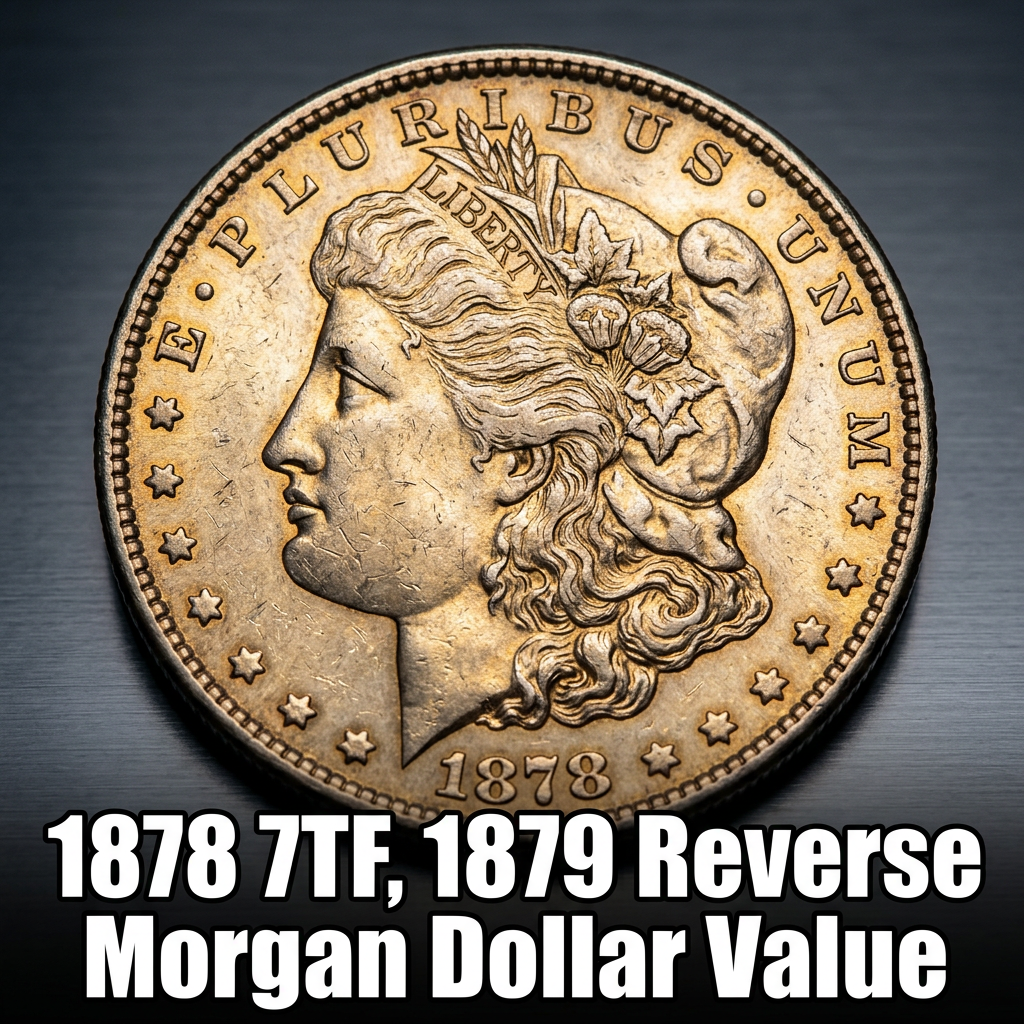

The 1878 7TF Morgan Dollar and the 1879 Reverse Morgan Dollar are worth anywhere from $30 in heavily worn condition to well over $1,000 or more in high mint state grades — and certain varieties can fetch thousands at auction. If you just found one of these old silver dollars, you may be sitting on something truly special.
What Makes the 1878 7TF Morgan Dollar So Interesting
The year 1878 was the very first year the Morgan Dollar was ever minted, which already makes it historically exciting. But within that first year, the U.S. Mint actually produced several distinct varieties — including coins with 8 tail feathers on the eagle, and then the corrected version with 7 tail feathers (7TF). The 7TF version is the one that ended up being the standard design moving forward.
Collectors love this coin because it represents a pivotal moment in American coinage history. The Mint was literally changing the design mid-production, which means different versions exist from the same year.
The “7TF” designation refers to the number of tail feathers on the reverse eagle. There’s also a sub-variety known as the “Reverse of 1878” and the “Reverse of 1879,” which adds another layer of complexity — and value — to these coins.
If you want to dig into detailed 1878 Morgan Dollar price data across different grades and varieties, that’s a great place to start understanding what your coin might be worth.
How to Tell the 1878 7TF Reverse Apart from the 1879 Reverse
This is where things get a little technical, but bear with us — it matters for your coin’s value.
The 1878 Morgan Dollar was produced with two distinct reverse (back side) designs. The “Reverse of 1878” features a flat breast on the eagle and parallel top arrow feather. The “Reverse of 1879” features a round breast on the eagle and a slanted top arrow feather. This second reverse style was used on some 1878-dated coins and then carried into 1879 production.
Coins struck with the 1878-dated obverse but the 1879 reverse design are noted as “1878 7TF Reverse of 1879” and are actually somewhat scarcer than the standard 1878 reverse version.
If you’re having trouble telling these varieties apart, a free coin identifier app can help you get a quick preliminary ID before you take it to a professional. Using a magnifying glass and comparing against reference images online is also a solid starting point.
1878 7TF and 1879 Reverse Morgan Dollar Value Chart
Here’s a general value breakdown based on condition and variety:
| Variety | Good (G-4) | Fine (F-12) | XF-40 | MS-63 | MS-65 |
|---|---|---|---|---|---|
| 1878 7TF Rev of 1878 | $35 | $45 | $75 | $425 | $2,500+ |
| 1878 7TF Rev of 1879 | $40 | $55 | $95 | $575 | $4,000+ |
| 1879 (Philadelphia) | $32 | $40 | $65 | $375 | $1,800+ |
| 1879-S Rev of 1878 | $35 | $48 | $80 | $700 | $5,500+ |
Note: Values are approximate retail estimates. Actual prices depend on strike quality, luster, and whether the coin is certified by PCGS or NGC.
Condition Is Everything — How to Grade Your Coin
One of the biggest mistakes everyday coin finders make is assuming all old coins are worth a fortune regardless of condition. With Morgan Dollars, condition is absolutely critical to value.
A heavily worn coin — where the hair above Lady Liberty’s ear is almost flat and the eagle’s feathers have merged together — might only bring $30 to $50 at a coin shop. But the same coin in uncirculated condition with original mint luster could be worth hundreds or even thousands.
Look for these signs of higher grade: sharp detail in Lady Liberty’s hair, clear feather definition on the eagle, no scratches or cleaning marks, and a natural silver tone rather than an artificially bright or dull surface.
CoinKnow is a handy app that helps you understand coin grading standards and get a ballpark value on coins just like these. It’s designed for regular people — not just seasoned collectors — so it’s a great tool if you’re new to this.
For a deeper look at 1878 silver dollar values broken down by grade and mint mark, you’ll find that even subtle differences in condition can swing the price dramatically.
Should You Get Your 1878 or 1879 Morgan Dollar Certified
If your coin looks like it’s in uncirculated or near-uncirculated condition, getting it professionally graded by PCGS or NGC is probably worth the investment. Certification protects the coin’s value, authenticates it, and makes it much easier to sell at full market price.
For coins in well-worn condition worth under $75, certification fees may not be economically worthwhile. But for coins that appear to be MS-63 or better, or for the rarer 1878 7TF Reverse of 1879 variety, professional grading can significantly increase buyer confidence and sale price.
CoinKnow can also help you decide whether certification makes sense before you spend the money — it gives you a reasonable estimate of what your coin might be worth raw versus slabbed.
FAQ
Q: How do I know if my 1878 Morgan Dollar has 7 or 8 tail feathers?
A: Look at the eagle on the back of the coin and count the feathers fanning out from the tail. Seven tail feathers means you have the 7TF variety. Eight tail feathers is the earlier 1878 issue and also carries solid collector value. A magnifying glass makes this much easier to see clearly.
Q: Is the 1879 Reverse of 1878 (1879-S) worth more than a regular 1879 Morgan Dollar?
A: Yes, generally speaking. The 1879-S with the Reverse of 1878 design is a recognized variety that collectors specifically seek out, and in higher grades it commands a noticeable premium over the standard 1879-S coin. The CoinKnow app can help you identify which variety you have and give you a sense of the value difference.
Q: My 1878 Morgan Dollar looks shiny and bright — does that mean it’s uncirculated?
A: Not necessarily. Many older coins were cleaned or polished over the years, which creates an artificial shine but actually damages the coin’s surface and reduces its collector value. Genuine uncirculated coins have a soft, satiny luster rather than a harsh brightness. If in doubt, have it looked at by a local coin dealer or submit it to a grading service.