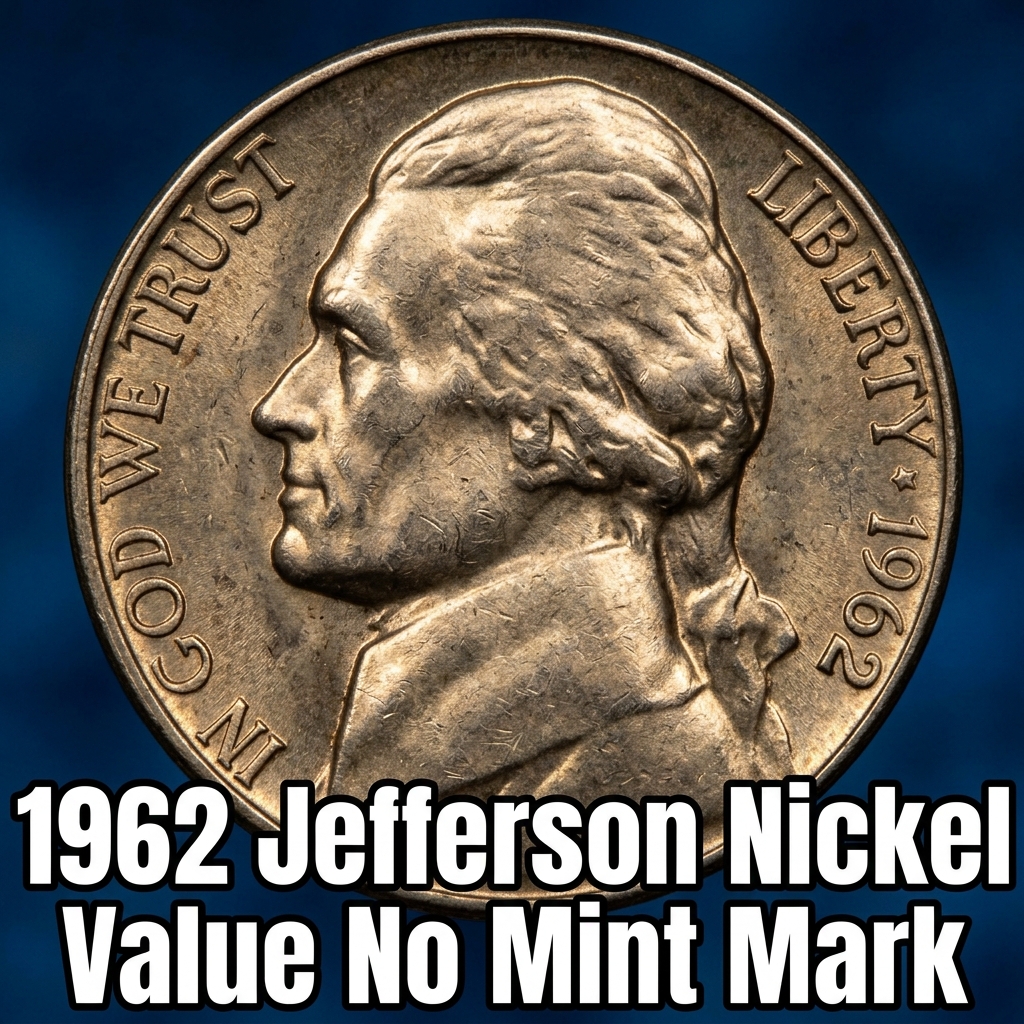

The 1962 Jefferson Nickel with no mint mark is worth anywhere from 5 cents in heavily worn condition to over $100 or more in pristine uncirculated grades. If you’ve got one of these coins sitting in a drawer or jar, you might be pleasantly surprised — some are worth real money depending on their condition.
What the No Mint Mark Means on a 1962 Nickel
When you see a 1962 Jefferson Nickel with no mint mark, that simply means it was struck at the Philadelphia Mint. Back in 1962, Philadelphia didn’t put a “P” mint mark on nickels — that practice didn’t begin until 1980. So the absence of a mint mark is completely normal for this coin.
The Philadelphia Mint produced over 97 million of these nickels in 1962, making them relatively common in circulated grades. But common doesn’t always mean worthless.
A well-preserved example with sharp details and original luster can still fetch a solid premium, especially among collectors who are building complete Jefferson Nickel sets. If you’re unsure whether your coin has a mint mark at all, a free coin identifier app can help you quickly scan and identify your coin from your phone.
1962 Jefferson Nickel No Mint Mark Value by Grade
Condition is everything when it comes to coin values. A 1962 nickel that’s been rattling around in someone’s pocket for decades will look very different from one that was stored carefully in a collection.
Here’s a breakdown of approximate values based on grade:
| Grade | Description | Estimated Value |
|---|---|---|
| Good (G-4) | Heavy wear, major details visible | $0.05 – $0.10 |
| Fine (F-12) | Moderate wear, all lettering clear | $0.10 – $0.25 |
| Extremely Fine (EF-40) | Light wear on high points | $0.50 – $1.00 |
| Uncirculated (MS-60) | No wear, some bag marks | $2 – $5 |
| Choice Uncirculated (MS-65) | Strong luster, minimal marks | $15 – $40 |
| Gem Uncirculated (MS-67+) | Exceptional quality, virtually perfect | $100+ |
You can explore detailed 1962 Jefferson Nickel MS grade price data to see how individual auction results compare across different mint state levels.
Full Steps — The Detail That Can Dramatically Boost Value
One of the most exciting aspects of Jefferson Nickels is the “Full Steps” designation. On the reverse of the coin, Monticello’s front steps should be sharply struck with complete, unbroken horizontal lines.
Coins that show five or six fully defined steps are labeled FS (Full Steps) by grading services like PCGS and NGC. This designation can multiply the value significantly.
For example, a 1962 Jefferson Nickel graded MS-65 might be worth around $15–$40 in normal condition — but an MS-65 Full Steps example can jump to $100 or more. An MS-66 FS coin has sold for several hundred dollars at major coin auctions.
If your coin appears to have crisp, clean steps on Monticello, it’s worth getting a closer look. CoinKnow can help you scan the coin and quickly flag key features like step definition, making it easier to decide if professional grading is worth the cost.
Proof Coins vs. Business Strike — Don’t Confuse Them
In 1962, the U.S. Mint also produced Proof Jefferson Nickels as part of proof sets. These coins were struck with specially polished dies on polished planchets, giving them a mirror-like finish and extremely sharp detail.
Proof 1962 Jefferson Nickels are not the same as regular circulated coins. They were made for collectors, not for spending, and they typically come in a 5-coin set.
A Proof 1962 nickel in PR-65 condition is generally worth $5–$15. Deep cameo proofs (PR-66 DCAM or higher) can fetch $50 to $200 depending on eye appeal and certification. If your coin has an almost-glassy appearance with frosted design elements, it may be a proof — and worth having assessed.
Is Your 1962 Nickel Worth Getting Graded?
Most circulated 1962 Jefferson Nickels aren’t worth the cost of professional grading, which typically runs $20–$50 per coin through PCGS or NGC. But if your coin looks absolutely pristine with no wear, strong luster, and what appear to be full steps on Monticello — it could be worth submitting.
To get a quick first opinion before spending money on grading, download CoinKnow and use its AI-powered coin scanning feature to assess condition and estimate value from home. It’s a smart first step before committing to professional services.
For a full breakdown of what your 1962 nickel is worth across all grades and varieties, including mint mark comparisons, it’s worth spending a few minutes researching before selling or submitting.
—
Frequently Asked Questions
Q: Is a 1962 nickel with no mint mark rare?
A: Not particularly. The Philadelphia Mint struck over 97 million 1962 Jefferson Nickels, so they’re common in circulated grades. However, high-grade examples — especially those with Full Steps — are scarce and genuinely valuable.
Q: How do I know if my 1962 nickel has Full Steps?
A: Look at the reverse side at the base of Monticello. You should see a row of horizontal lines representing the front steps. If five or six lines are complete and unbroken, your coin may qualify for the Full Steps designation. A magnifying glass or loupe (10x) makes it easier to see. You can also use CoinKnow to get a quick visual assessment from your smartphone.
Q: Where is the mint mark on a 1962 Jefferson Nickel?
A: On 1962 Jefferson Nickels, the mint mark appears on the reverse side, to the right of Monticello. A “D” means it was struck at the Denver Mint. If there’s no letter, it came from Philadelphia — which was the standard practice at the time.