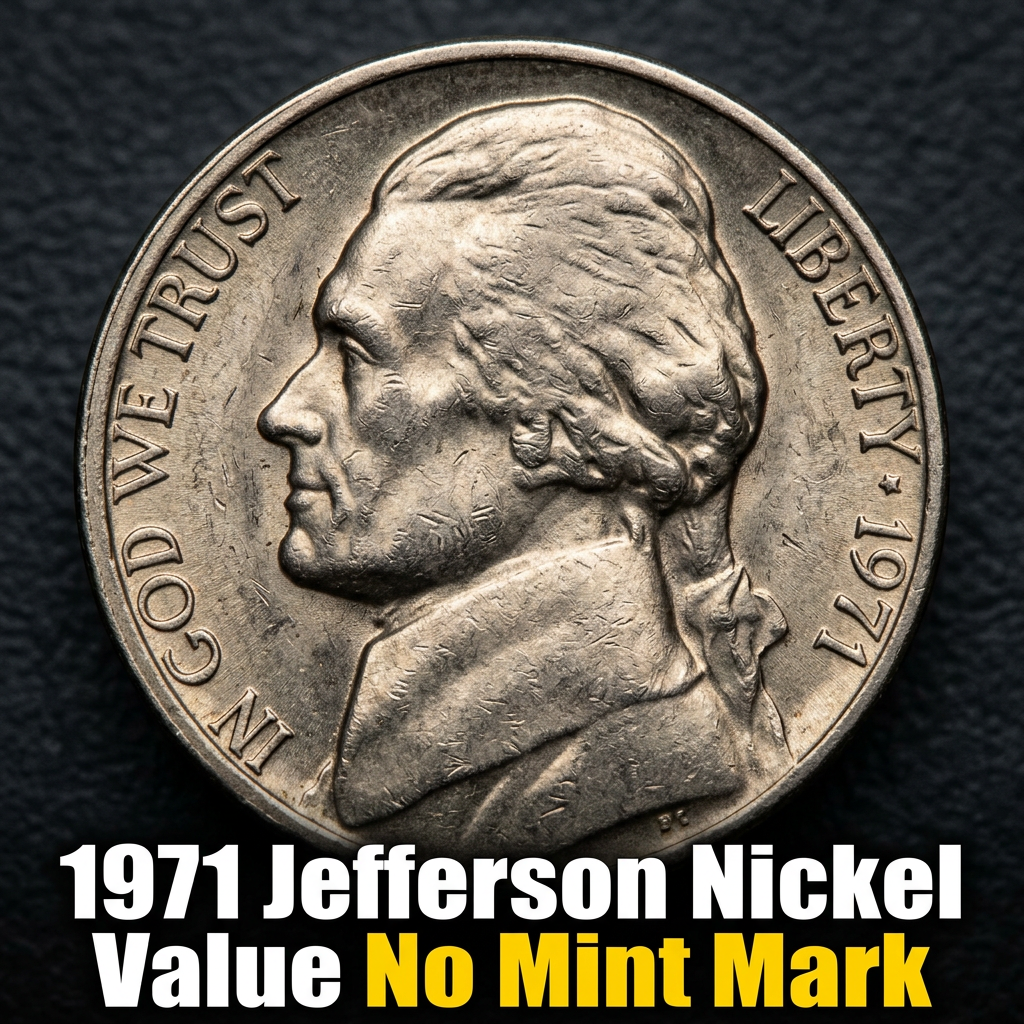

The 1971 Jefferson Nickel with no mint mark is worth between $0.05 and $5 for most circulated examples, but well-preserved mint state coins can fetch $20 or more. If you found one of these in your change jar, you’re in the right place — let’s break down exactly what it’s worth and why.
When you’re trying to identify an old coin quickly, tools like a free coin identifier app can save you a lot of time. Instead of spending hours digging through price guides, you can scan your coin and get an instant read on its condition and approximate value. Once you know what you’re holding, the deeper research becomes a whole lot easier.
What Is the 1971 Jefferson Nickel No Mint Mark?
The 1971 Jefferson Nickel with no mint mark was struck at the Philadelphia Mint. Back in 1971, Philadelphia did not place a mint mark on its coins, which is why you’ll find no letter under the date. That’s completely normal — it doesn’t make the coin rare or defective.
The U.S. Mint produced over 106 million of these nickels in 1971, which means they’re common in circulation. Most people come across them in pocket change or old coin rolls. The coin features Felix Schlag’s classic portrait of Thomas Jefferson on the obverse and Monticello on the reverse — a design that ran for decades before being updated in 2004.
Because of the high mintage, most worn 1971 nickels are worth only face value. But coins in excellent condition are a different story.
How Much Is a 1971 Nickel No Mint Mark Worth?
The value depends almost entirely on the coin’s condition, also called its grade. A heavily circulated coin with scratches and worn details is worth about five cents. A lightly worn example in very fine condition might bring $0.25 to $1 at best.
The real value shows up in uncirculated grades. Coins graded MS-65 or higher by a professional grading service like PCGS or NGC can be worth $10 to $50 or more. In top grades like MS-67, a 1971 Philadelphia nickel has sold for over $100 at auction.
Check out this detailed breakdown of 1971 Jefferson Nickel mint state prices to see exactly how values change across different grades. It’s one of the most useful quick references out there for this specific coin.
| Grade | Condition | Estimated Value |
|---|---|---|
| Good (G-4) | Heavy wear, details visible | Face value (~$0.05) |
| Very Fine (VF-20) | Light to moderate wear | $0.25 – $0.75 |
| Extremely Fine (EF-40) | Slight wear on high points | $0.75 – $2 |
| MS-63 | Uncirculated, minor marks | $3 – $8 |
| MS-65 | Gem uncirculated | $10 – $25 |
| MS-67+ | Superb gem, top grade | $75 – $150+ |
Are There Any Rare or Error 1971 Nickels Worth More?
Yes, and this is where it gets interesting. Error coins from the 1971 Philadelphia Mint do exist, and some are worth serious money. The most talked-about variety is the 1971 doubled die obverse, where certain design elements appear slightly doubled due to a hub error during the die-making process.
A doubled die 1971 nickel in collectible condition can fetch $50 to several hundred dollars depending on how strong the doubling is and the coin’s grade. Other errors to look for include off-center strikes, clipped planchets, and die cracks.
If you think you might have an error coin, CoinKnow is a great resource to help you identify unusual features before spending money on professional grading. The app walks you through what to look for and gives you a realistic value estimate based on current market data.
How to Check Your 1971 Nickel’s Value at Home
Start by examining your coin under good light with a magnifying glass. Look at Jefferson’s hair above his ear and the steps of Monticello — these areas wear first and tell you a lot about grade.
If the coin looks bright, untouched, and has visible luster (a slight shine), it’s likely uncirculated and worth grading. You can get a quick estimate using CoinKnow, which uses your phone camera to assess condition and match your coin to recent sale prices.
For a fuller picture of what your coin might be worth today, this complete 1971 nickel value guide with current pricing covers circulated and mint state values in one place. It’s a solid starting point for anyone who wants to understand the market before deciding whether to sell.
If you believe you have a high-grade or error coin, consider submitting it to PCGS or NGC for professional certification. A certified MS-65 or better coin is far easier to sell and will almost always bring a higher price than a raw (uncertified) example.
Should You Hold On to Your 1971 Jefferson Nickel?
For most people, a worn 1971 nickel is just a nickel. But if yours looks clean, shiny, and uncirculated, it could be worth holding onto — especially if it grades MS-65 or above.
Error coins are always worth investigating further. Even a small doubled die can turn a five-cent coin into a fifty-dollar coin with the right buyer.
Use CoinKnow to do your homework first. It’s free to get started, and it could tell you whether your coin deserves a closer look or should go back in the change jar.
FAQ
Q: Why does my 1971 nickel have no mint mark — is it missing?
A: No, it’s not missing. In 1971, the Philadelphia Mint did not add a mint mark to its coins. A blank space below the date simply means your coin was made in Philadelphia, which is totally normal.
Q: What 1971 nickel errors are worth the most money?
A: The doubled die obverse is the most valuable error variety for the 1971 Jefferson Nickel. Strong examples in mid-grades can bring $50 to $200 or more. Off-center strikes and clipped planchets also carry premiums depending on severity.
Q: Is it worth getting my 1971 nickel professionally graded?
A: Only if the coin appears uncirculated and shows strong luster, or if you suspect it’s an error coin. Grading fees can run $20–$40 per coin, so it only makes financial sense if the coin has a realistic chance of being worth significantly more than that in a certified holder.