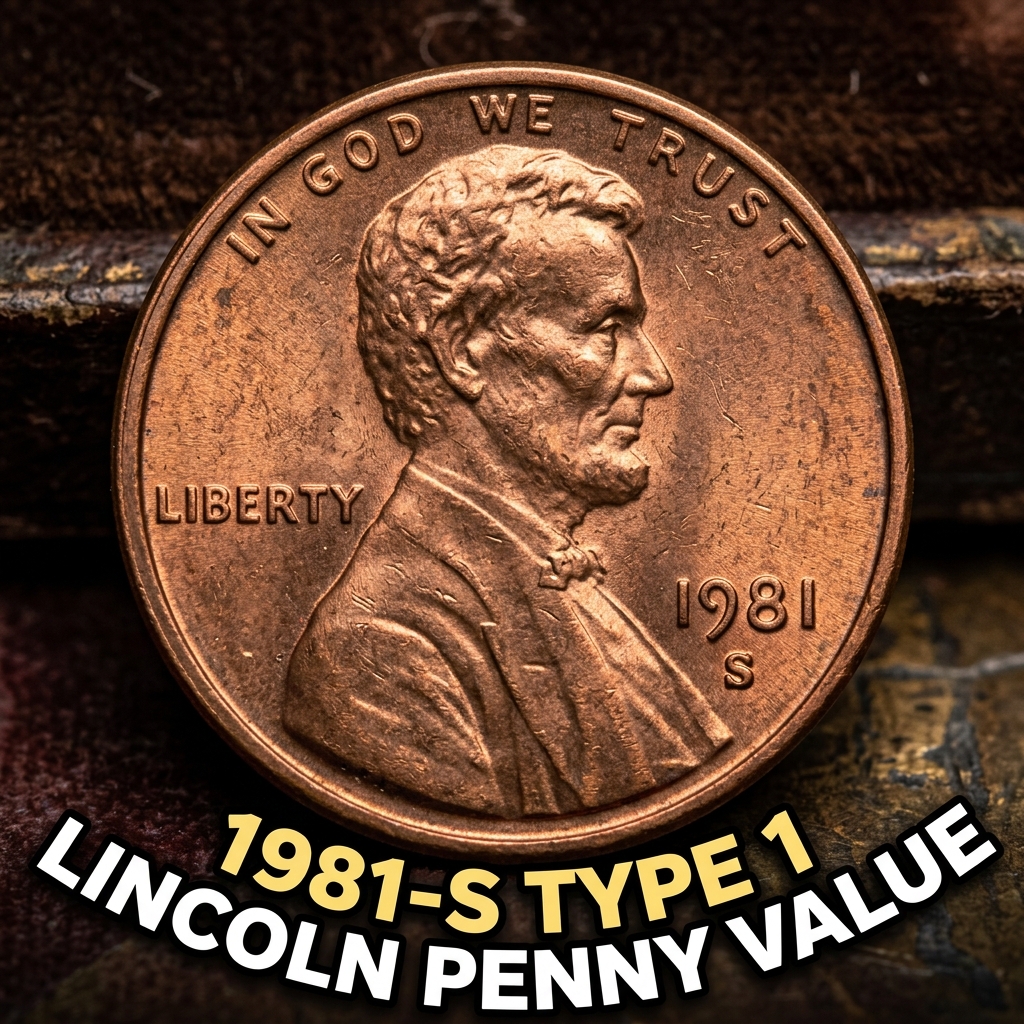

The 1981-S Type 1 Lincoln Penny is worth anywhere from $1 to $2 in typical circulated condition, but in pristine proof grades, it can fetch $5 to $15 or more — and top-grade examples have sold for much higher at auction. If you’ve come across one of these coins, you’re in the right place to find out exactly what it’s worth.
If you’re not sure which variety you have, you’re not alone. The 1981-S penny comes in two types, and telling them apart takes a careful eye. Using a free coin identifier app is one of the easiest ways to get started — just snap a photo and let the technology do the heavy lifting before you dig deeper into grading or valuation.
What Makes the 1981-S Type 1 Lincoln Penny Special
The 1981-S Lincoln Penny was struck at the San Francisco Mint and was produced exclusively as a proof coin — meaning it was never intended for everyday pocket change. Proof coins are specially made for collectors, struck on polished planchet blanks with carefully prepared dies to create a mirror-like finish and sharply defined details.
The “Type 1” designation is what separates this coin from its sibling, the Type 2. The Type 1 has a filled “S” mintmark, meaning the loops of the letter appear closed and rounded. The Type 2, introduced later in the year, features a clearer, more open “S” mintmark. Both came from the same mint, but the mintmark punch changed partway through production.
Because the 1981-S Type 1 is a proof issue with collector appeal, condition matters enormously. A coin with haze, hairlines, or handling marks will bring significantly less than a perfectly preserved, deep cameo example.
1981-S Type 1 Lincoln Penny Value by Grade
Proof coins are graded on the standard Sheldon scale from PR-60 to PR-70, with deep cameo (DCAM) designations adding extra value. Here’s a general look at what you can expect:
| Grade | Designation | Estimated Value |
|---|---|---|
| PR-65 | Cameo | $3 – $6 |
| PR-67 | Deep Cameo | $8 – $15 |
| PR-68 | Deep Cameo | $15 – $40 |
| PR-69 | Deep Cameo | $50 – $100+ |
| PR-70 | Deep Cameo | $200 – $500+ |
For detailed 1981 Lincoln Penny price data across multiple grades and conditions, it’s always a good idea to cross-reference current auction results, since the market for proof coins can shift based on recent sales.
How to Tell Type 1 from Type 2
One of the most common questions collectors have is how to reliably distinguish the two 1981-S varieties. The key difference lies entirely in the mintmark shape. On the Type 1, the “S” looks slightly blobby or filled — the inner curves of the letter don’t have a lot of separation. On the Type 2, the “S” is crisper and more open, looking closer to a traditional letter shape.
You’ll need at least a 5x loupe or magnifying glass to see this clearly. Lighting matters too — try tilting the coin under a single light source to catch the details in the mintmark area.
If you’re unsure, CoinKnow is a great tool to help you identify the variety quickly. The app lets you zoom in on mintmark details and compare your coin against known reference images. It’s especially handy when you’re sorting through a proof set and want to confirm which type you have before listing it for sale.
Where These Coins Come From and How Many Exist
The 1981-S proof Lincoln Penny was issued as part of the U.S. Mint’s annual proof set, which was a popular gift for collectors throughout the 1980s. Mintage for the 1981-S proof penny was approximately 4 million coins, but that includes both Type 1 and Type 2 combined. The Type 1 was produced earlier in the year before the mintmark punch was replaced, so it’s considered somewhat less common than the Type 2.
Many of these coins still exist in their original proof sets, which can preserve them in excellent condition. If you have a full 1981 proof set, it’s worth examining every coin carefully. You might find that the Lincoln cent inside is a Type 1 — and that detail could matter to a specialist collector.
For a broader look at what 1981 pennies are worth across all mint marks and varieties, checking a dedicated reference guide will give you the full picture of this year’s coinage.
Is the 1981-S Type 1 Penny Worth Holding Onto
For most people, the 1981-S Type 1 Lincoln Penny isn’t a life-changing find — but it’s a legitimate collectible with real demand from proof set enthusiasts and variety collectors. A well-preserved example in a high-grade deep cameo holder can bring meaningful money, especially at specialized numismatic auctions.
If you found yours loose and unprotected, the value depends heavily on how much it has been handled. Even small hairlines can drop a proof coin from PR-68 territory down to PR-65, which makes a significant difference in price. Store it in a coin flip or holder right away if you haven’t already.
CoinKnow can help you assess surface quality, grade range, and current market comparisons all in one place — a solid first step before you decide whether to sell, hold, or submit the coin for professional grading through PCGS or NGC.
FAQ
Q: How do I know if my 1981-S penny is Type 1 or Type 2?
A: Look closely at the “S” mintmark under magnification. A Type 1 has a filled, rounded “S” with less open space inside the curves. A Type 2 has a cleaner, more distinct “S” shape. Using CoinKnow or a reference guide with side-by-side images makes this much easier to confirm.
Q: Is the 1981-S Type 1 Lincoln Penny rare?
A: It’s not rare in an absolute sense — millions were produced — but it is less common than the Type 2, and high-grade deep cameo examples are genuinely hard to find. Collectors who specialize in proof sets actively look for well-preserved Type 1 examples.
Q: Should I get my 1981-S Type 1 penny professionally graded?
A: If your coin shows strong cameo contrast and no visible flaws under magnification, professional grading through PCGS or NGC could be worthwhile. A PR-69 or PR-70 Deep Cameo label adds credibility and can significantly increase what buyers are willing to pay.