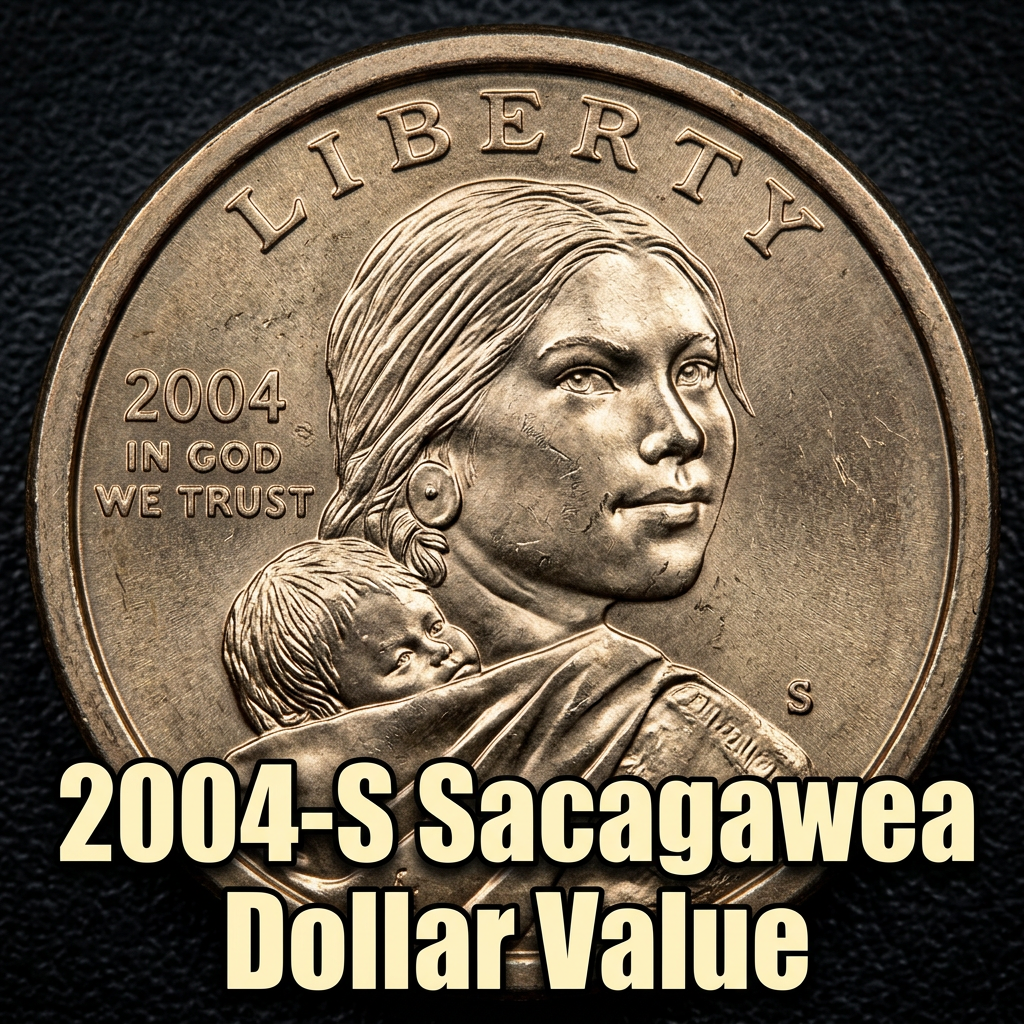

The 2004-S Sacagawea Dollar is worth anywhere from $5 in average condition to over $50 or more for top-grade proof examples — and if you’ve got one sitting in an old collection, it could be worth more than you think.
What Makes the 2004-S Sacagawea Dollar Special
The “S” mint mark tells you everything. This coin was struck at the San Francisco Mint, which is famous for producing proof coins — not coins meant for everyday spending, but beautifully struck pieces made specifically for collectors.
Proof coins go through a special minting process. The dies are polished, and the blanks are specially prepared before striking. The result is a coin with mirror-like fields and sharp, frosted details that regular circulation coins simply don’t have.
If you’re holding a 2004-S Sacagawea Dollar, chances are it came from a proof set. These were sold directly by the U.S. Mint to collectors, so most examples you’ll find today are still in great condition. That’s actually good news for you — it means your coin has a real shot at being worth something.
Not sure what you’re looking at? A free coin identifier app can help you confirm the date, mint mark, and whether your coin shows any special varieties that could bump up its value.
2004-S Sacagawea Dollar Value by Grade
Coin values are always tied to condition — or what collectors call “grade.” Proof coins are graded on the same 70-point scale, but the labels you’ll see are PR (Proof) or PF instead of MS (Mint State).
Here’s a general breakdown of what a 2004-S Sacagawea Dollar is worth based on its grade:
| Grade | Description | Estimated Value |
|---|---|---|
| PR-65 | Gem Proof, minor blemishes | $5 – $8 |
| PR-67 | Superb Gem, very clean surfaces | $10 – $18 |
| PR-69 | Near-perfect, deep cameo contrast | $20 – $35 |
| PR-70 DCAM | Perfect Deep Cameo Proof | $50 – $100+ |
The biggest value jump happens at the PR-69 and PR-70 Deep Cameo (DCAM) levels. “Deep Cameo” refers to the strong contrast between the frosted portrait of Sacagawea and the mirror-like background — it’s visually stunning and highly sought after by collectors.
For detailed and up-to-date 2004-S Sacagawea Dollar price data across grades, it’s worth checking a trusted coin pricing database to see recent sale trends.
How to Tell If Your Coin Is a Deep Cameo
The Deep Cameo designation can significantly increase what your 2004-S Sacagawea Dollar is worth, so it’s important to know what to look for.
Hold the coin under a light and tilt it slightly. If the raised design elements — like Sacagawea’s face and the eagle on the reverse — appear frosty or white, while the flat background looks like a clear mirror, congratulations: you likely have a cameo or deep cameo coin.
Coins graded PR-70 DCAM are essentially perfect. They show no contact marks, no hairlines from cleaning, and full deep cameo contrast. These are the coins that sell for the highest prices at auction.
If your coin has been cleaned or shows scratches, that will hurt its grade and value. Never clean a proof coin — it’s one of the fastest ways to destroy value.
CoinKnow is a popular app among collectors that can walk you through the grading basics and help you understand what characteristics to look for when evaluating your own coins.
How Many Were Minted and Why That Matters
The 2004-S Sacagawea Dollar had a mintage of approximately 2.96 million coins — all produced as proof strikes for collector sets. That might sound like a lot, but compared to circulation coins that can have mintages in the hundreds of millions, it’s relatively modest.
Lower mintage generally means stronger long-term collector demand. And because these coins were sold in sets and often stored carefully, the supply of high-grade examples is more predictable than with older coins.
That said, raw (ungraded) proof coins are still quite affordable. If you want to maximize your coin’s value, professional grading by PCGS or NGC is the way to go — especially if you believe your coin could hit PR-69 or PR-70 DCAM.
You can explore a full breakdown of 2004 Sacagawea Dollar values and what collectors are paying today to see how your coin stacks up in the current market.
CoinKnow also offers tools to help you track graded coin values over time, which is handy if you’re deciding whether to sell now or hold onto your piece.
Should You Get It Graded or Just Sell It Raw?
This is a common question, and the honest answer depends on what grade you think the coin can achieve. Professional grading costs money — typically $20 to $50 per coin depending on the service — so it only makes financial sense if the coin is likely to come back at PR-69 or higher.
For most 2004-S Sacagawea Dollars that came out of standard proof sets, a grade of PR-68 or PR-69 is realistic. At PR-70 DCAM, you’re looking at coins that were exceptionally well-struck and have been perfectly preserved.
If you’re unsure, use CoinKnow to get a preliminary sense of condition before spending money on professional grading. It’s a smart first step.
—
FAQ
Q: Is the 2004-S Sacagawea Dollar rare?
A: It’s not considered rare by strict numismatic standards, but with a mintage of under 3 million and all coins being proof strikes, it has more collector appeal than common circulation coins. High-grade examples, especially PR-70 DCAM, are genuinely scarce.
Q: Can I find a 2004-S Sacagawea Dollar in everyday change?
A: Almost certainly not. The “S” mint mark indicates a San Francisco proof coin, which was only sold in collector sets — never released into general circulation. If you found one, it came from a collection, not your pocket change.
Q: What’s the best way to store a 2004-S Sacagawea Dollar to preserve its value?
A: Keep it in its original proof set packaging if possible. If it’s been removed, store it in a hard plastic coin holder (not a soft flip) away from humidity and direct sunlight. Never touch the surface of the coin with bare fingers — oils from your skin can cause long-term damage to the mirrored fields.