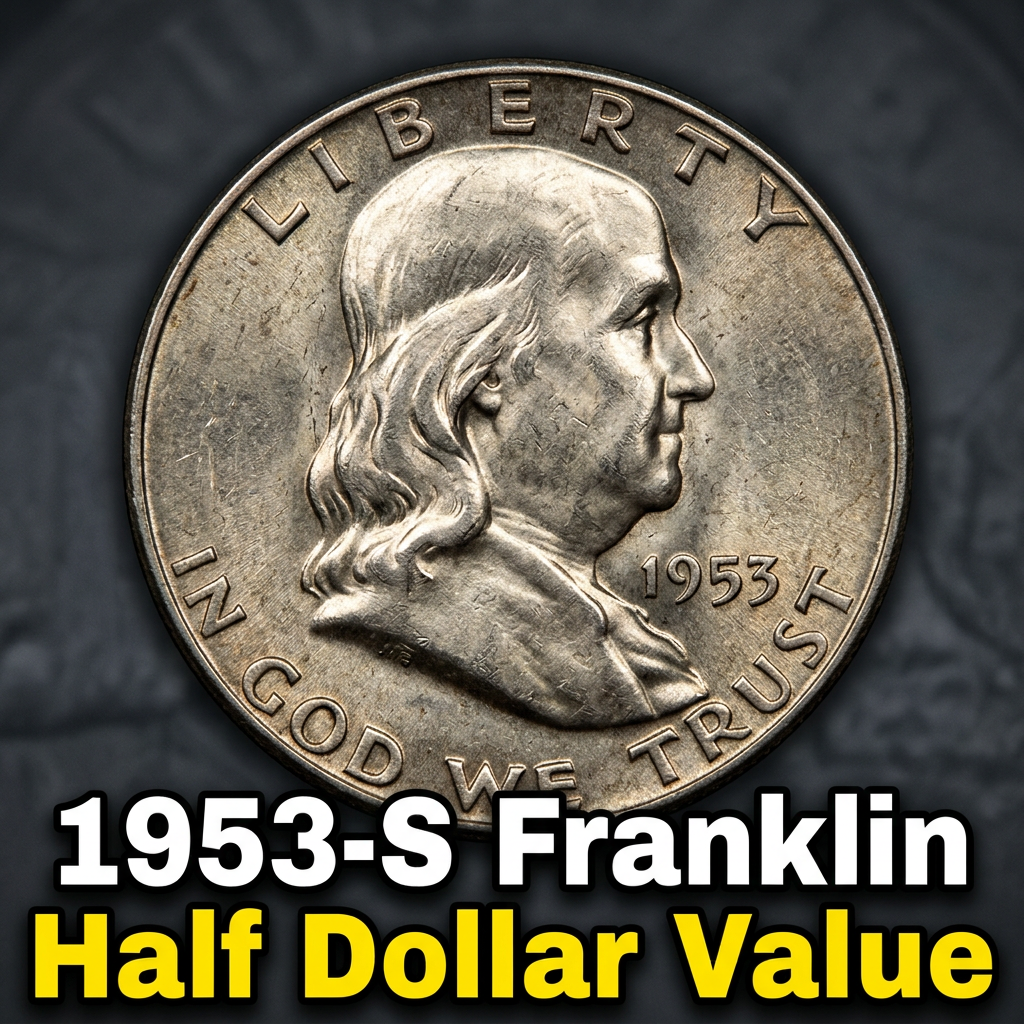

The 1953-S Franklin Half Dollar is worth anywhere from $10 in heavily worn condition to over $500 or more in top mint state grades — and a few exceptional examples have crossed the $1,000 mark at auction. If you found one of these silver coins in an old collection or inherited it from a relative, you might be sitting on something genuinely valuable. Read on to find out exactly what yours could be worth.
What Is the 1953-S Franklin Half Dollar?
The 1953-S Franklin Half Dollar was struck at the San Francisco Mint and carries the small “S” mintmark on the reverse, just above the Liberty Bell. It’s part of the Franklin Half Dollar series, which ran from 1948 to 1963. These coins are made of 90% silver, which already gives them a baseline melt value before you even factor in collector demand.
The 1953-S had a mintage of around 4.1 million coins — not exactly rare, but certainly not common either. San Francisco-minted Franklins from this era are known for their quality, and collectors often seek them out for their Full Bell Lines (FBL) designation, which we’ll explain below.
If you’re not sure what you have, a free coin identifier app can help you snap a photo and get a fast read on the coin’s details before you dig deeper into its value.
1953-S Franklin Half Dollar Value by Grade
The condition of your coin matters enormously. Coin grading runs from Poor (P-1) at the bottom to Mint State 70 (MS-70) at the top. For most people, the coins they find are either circulated (used as money) or uncirculated (kept in a collection from the start).
Here’s a general look at what the 1953-S Franklin Half Dollar is worth across different grades:
| Grade | Description | Estimated Value |
|---|---|---|
| Good (G-4) | Heavy wear, major details visible | $10 – $12 |
| Fine (F-12) | Moderate wear, clear lettering | $12 – $15 |
| Extremely Fine (EF-45) | Light wear on high points | $16 – $22 |
| Mint State (MS-63) | Uncirculated, some contact marks | $35 – $65 |
| Mint State (MS-65) | Gem uncirculated, sharp strike | $100 – $250 |
| MS-65 FBL | Full Bell Lines designation | $400 – $800+ |
For more detailed 1953-S Franklin Half Dollar price data across mint state grades, it’s worth consulting a dedicated numismatic database to see recent auction results.
What Are Full Bell Lines and Why Do They Matter?
The Full Bell Lines (FBL) designation is one of the most important factors for Franklin Half Dollar values. On the reverse of the coin, the Liberty Bell features horizontal lines running across its lower portion. On many coins — even uncirculated ones — these lines are weak or incomplete because of die wear or poor striking.
When all the lines are sharp and fully defined, the coin earns an FBL designation from grading services like PCGS or NGC. This is a big deal.
A standard MS-65 1953-S might sell for $100–$250. The same coin with an MS-65 FBL designation can jump to $400, $600, or even more — sometimes 3 to 5 times the price. So if your coin looks especially crisp on the bell area, it’s worth having it professionally graded.
CoinKnow is a great starting point if you want a quick estimate before committing to professional grading fees.
Silver Melt Value — Your Floor Price
Even if your 1953-S Franklin Half Dollar is well-worn and not particularly collectible, it still has real value as silver. Each Franklin Half Dollar contains 0.3617 troy ounces of pure silver.
At a silver spot price of around $28 per ounce (prices fluctuate daily), the melt value works out to roughly $10–$11. That’s essentially your minimum — no matter how rough the coin looks, it’s worth at least that much in silver content alone.
This is why it’s never a great idea to spend or discard old silver coins without checking. Even a beat-up Franklin is worth saving.
You can find a comprehensive breakdown of 1953 half dollar value information including silver content and grade-based pricing to get a full picture of what your coin is worth today.
Tips for Getting the Best Price for Your 1953-S Franklin Half Dollar
If you think your coin might be valuable, here’s what to do:
Don’t clean it. Ever. Cleaning a coin destroys its surface and can turn a $300 coin into a $30 coin. Collectors and dealers can always tell.
Consider professional grading from PCGS or NGC if the coin looks uncirculated and sharp. The authentication adds credibility and can dramatically increase resale value, especially for FBL-quality pieces.
Compare recent sales on platforms like eBay (completed listings), Heritage Auctions, or Stack’s Bowers. Real sale prices are the best gauge of what buyers will actually pay today.
Use CoinKnow to get a fast, reliable estimate right from your phone before you decide whether to sell, hold, or send in for grading. It’s one of the easiest ways to get your bearings when you’re new to coin collecting.
And if you have multiple coins to evaluate, CoinKnow lets you scan and track your collection in one place — super handy if you inherited a whole box of old coins.
FAQ
Q: How do I know if my 1953-S Franklin Half Dollar has Full Bell Lines?
A: Look at the lower portion of the Liberty Bell on the reverse. There should be two distinct sets of horizontal lines — the lower set must be complete and unbroken for FBL designation. It’s easier to judge under magnification. If you’re unsure, a coin grading service will make the official call.
Q: Is the 1953-S rarer than other Franklin Half Dollars from that decade?
A: The 1953-S is moderately scarce compared to Philadelphia-minted Franklins from the same year, which had a much higher mintage. However, in FBL grades, the 1953-S becomes quite difficult to find in top condition, which drives up its value significantly among serious collectors.
Q: Where is the best place to sell a 1953-S Franklin Half Dollar?
A: For raw circulated coins, a local coin dealer or eBay can work fine. For uncirculated or FBL-quality coins, consider major auction houses like Heritage Auctions for maximum exposure to serious buyers. Getting the coin graded first often increases your final sale price considerably.