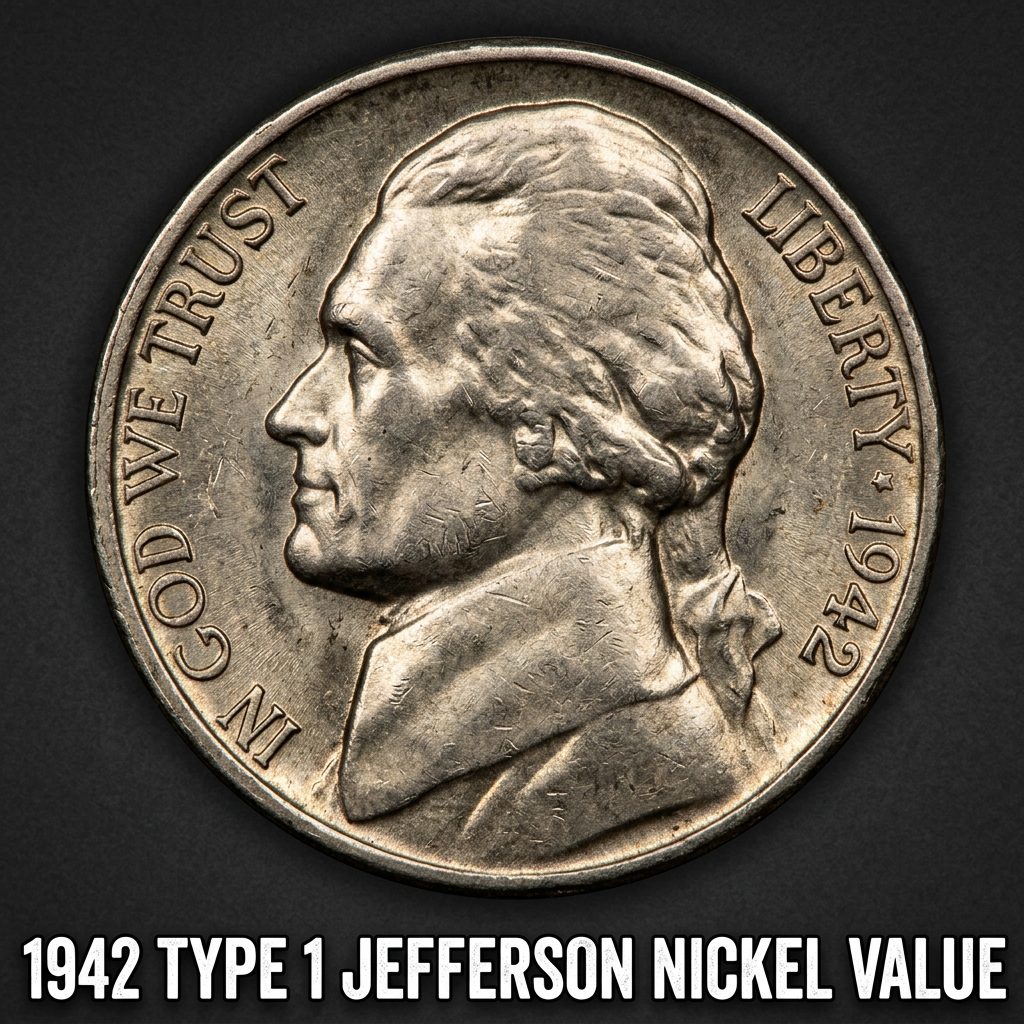

The 1942 Type 1 Jefferson Nickel is worth anywhere from $0.25 in heavily worn condition to over $100 or more in pristine mint state — and some rare specimens fetch even higher prices. If you found one of these nickels in an old jar or inherited a coin collection, you’re in the right place to find out what it’s really worth.
If you’re not sure what type of nickel you’re holding, a free coin identifier app can help you figure it out quickly before diving into the value details. Knowing your coin’s exact type, mint mark, and condition is the first step to understanding its worth.
What Makes the 1942 Type 1 Jefferson Nickel Special
The year 1942 is a fascinating one in U.S. coin history. When World War II ramped up, the government needed nickel for the war effort — so the U.S. Mint switched the five-cent coin’s composition mid-year. The “Type 1” refers to the original pre-war composition of 75% copper and 25% nickel, minted before the wartime alloy (silver-based) took over.
This means two very different nickels were produced in 1942. The Type 1 looks like a regular pre-war Jefferson nickel, while the Type 2 (wartime) has a large mint mark above Monticello.
Coins from this transitional year carry extra historical interest for collectors, and that story adds to the value — especially in higher grades.
1942 Type 1 Jefferson Nickel Value by Grade and Mint Mark
The value of your 1942 Type 1 nickel depends heavily on its condition (grade) and where it was minted. Coins come from Philadelphia (no mint mark) and Denver (D mint mark). For the most up-to-date 1942 Jefferson Nickel mint state price data, it’s worth checking current market figures before buying or selling.
Here’s a general value breakdown:
| Coin | Good (G-4) | Fine (F-12) | Extremely Fine (EF-40) | MS-63 | MS-65 |
|---|---|---|---|---|---|
| 1942 (Philadelphia) | $0.25 | $0.50 | $1.50 | $18 | $55 |
| 1942-D (Denver) | $0.25 | $0.60 | $2.00 | $22 | $70 |
| 1942 Proof (Philadelphia) | — | — | — | $55 | $100+ |
Note: Full Steps (FS) designations — where the steps of Monticello are sharply defined — can dramatically increase value, sometimes pushing MS-65 FS coins well above $200.
How to Tell What Condition Your 1942 Type 1 Nickel Is In
Grading coins takes practice, but here are some basics that can help you estimate where your coin falls.
A coin in “Good” condition is heavily worn, with most major design features visible but flat. You can still see Jefferson’s profile and the word “MONTICELLO,” but there’s little to no detail in the hair or steps.
“Fine” to “Extremely Fine” coins show moderate to light wear. Jefferson’s cheekbone and hair lines are visible, and the steps of Monticello may have some definition.
Mint State (MS) coins are uncirculated — they never spent time in a pocket or cash register. These are the most valuable. Look for original luster and sharp details under a magnifying glass.
For a more detailed breakdown of what your 1942 nickel is worth based on its grade and condition, including high-resolution photo comparisons, coin value guides are your best friend.
Using Technology to Identify and Value Your Coin
You don’t have to be a coin expert to figure out what you have. Apps like CoinKnow are designed for everyday people who stumble across old coins and want real answers fast.
CoinKnow lets you scan your coin with your phone camera and instantly get identification results, including the year, mint mark, type, and estimated value range. It’s especially handy for coins like the 1942 nickel, where small details — like the absence or presence of a mint mark or the Full Steps designation — can mean big differences in value.
If you’re sitting on a small collection or just found a handful of old nickels in Grandma’s dresser drawer, CoinKnow is one of the easiest ways to start understanding what you’ve got without needing a coin dealer.
Is the 1942 Type 1 Jefferson Nickel Rare
In circulated grades, the 1942 Type 1 nickel is not rare — millions were minted that year. But in high mint state grades, particularly with the Full Steps designation, they become significantly harder to find.
The Philadelphia Mint struck over 49 million Type 1 nickels in 1942, and Denver added another 13 million. That’s a large mintage, which is why well-worn examples are common and inexpensive.
However, coins that survived in uncirculated condition with sharp strikes are another story. Collectors specifically seek out MS-65 FS and higher examples, and those can command strong premiums at auction. So don’t write off your 1942 Type 1 nickel too quickly — take a close look at those Monticello steps!
FAQ
Q: How do I know if my 1942 nickel is Type 1 or Type 2?
A: Look above the dome of Monticello on the reverse. Type 2 (wartime) nickels have a large mint mark — P, D, or S — above Monticello. Type 1 nickels have no mint mark there, or a small “D” to the right of Monticello. If you see a big letter above the dome, it’s a wartime silver nickel. If not, you likely have a Type 1.
Q: Are 1942 Type 1 Jefferson Nickels made of silver?
A: No. The Type 1 is the original pre-war composition of 75% copper and 25% nickel — no silver at all. Only the Type 2 wartime nickels from 1942–1945 contain 35% silver. If you want silver value, look for the large mint mark above Monticello.
Q: What’s the most valuable 1942 Type 1 nickel ever sold?
A: Exceptionally graded specimens with the Full Steps designation have sold for several hundred dollars or more at major auctions. A 1942 Philadelphia nickel graded MS-67 FS, for example, can bring $300–$500 or higher depending on eye appeal and market demand. Always check recent auction records for the most accurate figures.